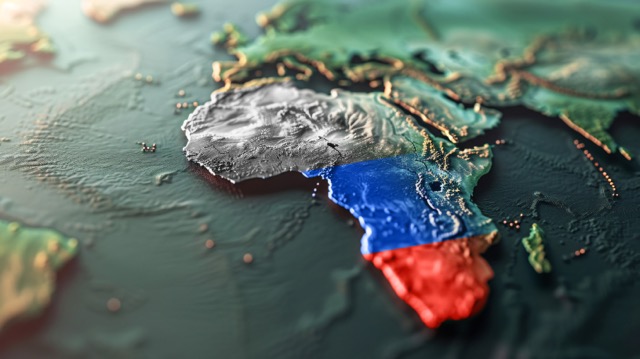
A Movie We’ve Seen Before: Russia’s Pitch for Africa
It came as no surprise last month to learn that the Russian Federation was luring able-bodied Africans to come, fight, and die at the front in Ukraine. Duped by promises of training and professional advancement, young Africans grab for the few available life rafts, even when chimerical.
Unable to eradicate poverty within its own borders, Russia converts penury in other countries to its advantage. Unwitting recruits from Africa help fill Russian military quotas when induction from Saint Petersburg, Moscow, and Yekaterinburg would likely destabilize and paralyze the Russian war effort in Ukraine and beyond.
The most recent evidence of this practice comes from South Africa, where the daughter of former president Jacob Zuma is alleged to have done the human trafficking, and is now under investigation. We can guess that this practice extends to other Sub-Saharan countries with less transparent judicial systems.
Russia’s actions in impoverished countries may be cynical and self-serving, but they astutely capitalize on open opportunities. Africa’s youth are not gullible. However, a dearth of truthful information, combined with Russia’s brilliant disinformation campaigns, brings them rare scraps of hope, and they follow them. Western governments are not good at social messaging or propaganda, nor should they be. Understanding the roots of Russian strategic advances will be essential to countering them.
Russia sent delegates to the 1884 Berlin Conference, the starting point for the “Scramble for Africa.” However, unlike its counterparts from Belgium, France, Spain, Portugal, and Italy, Czar Alexander II’s Russia had no pre-cooked advances on any particular slices of territory or trade, so it went unsullied into the coming colonial period. This came to the Soviet Union a century later as a lucky break when it could take credit for having no colonies (de jure!) while the Western states feasted on Africa’s natural resources.
The USSR’s involvement in the proxy battles of the Cold War added vast cruelties to those of the colonizers, and Africans suffered relatively equally from both sides. Western- and Soviet-backed factions presented themselves as liberators, but there were few real examples of either. FRELIMO and RENAMO in Mozambique, UNITA and MPLA in Angola, SSM and SSDF in Somalia, most were bonnet blanc, blanc bonnet -- six of one, half a dozen of the other. According to urban legend, during the predatory reign of Western-backed Mobutu Sese Seko in Zaire, peasants up-country mused, “Ok, point made. But when can we expect the Belgians back?”
The USSR supported the African National Congress (ANC) in South Africa in the late stages of the Cold War, gaining the trust and gratitude of the ruling ANC of today. In the early days of the Yeltsin regime, Nelson Mandela was challenged by Western nations to explain his support of Russia and its agenda. He angrily replied that the USSR had been the only source of support for the anti-apartheid regime in his country.[1] Current President Ramaphosa is not alone in dealing openly with the Russian Federation, attending its summits, and welcoming its military and diplomatic advances in his country.
The troubled “rules based international order,” created by Western counties mainly for themselves and violated plenty of times for self-interest, went for decades with reexamination. The RBIO is no longer, as far as the Global South is concerned, and long live the RBIO.
We should acknowledge the shortcomings of powerful nations in Africa. “Collaboration” tilted mainly toward Western benefit, with little regard for Africans’ needs or wishes. Russia did not create the bitter aftertaste, did not need to. But it benefits from a history absent nineteenth century land grabs, and some shrewd moves into troubled spaces marked by Western adventurism.
Russia has made easy work of bringing military and diplomatic equities to the Sahel and other regions for self-serving purposes. Adding a few lies to a sound anti-colonial narrative has served it well. The Russian talent for disinformation draws on three centuries of experience and remains unparalleled. Putin’s Russia derives from the Cold War period and includes the lust for gold and rare earths, as well as an erosion of UN member states’ disapproval of its aggressive actions in Ukraine and elsewhere. But other things are brewing below the surface. How does the hard-pressed nation manage to come up with such exploitative vigor while inflicting on Europe the most lethal conflict since World War II?
We consider Alexander Dugin a sort of Rasputin to Putin’s logic in reversing the decline of the Russian Empire and creating a loopy “root causes” narrative for war. But even sophistry can contain elements of sincerity. It can be edifying to hear Dugin on this subject:
Culturally speaking, we are fighting against the ideology of a unipolar world, against globalist hegemony. The more sovereign poles emerge in the world today, the easier it will be for us to bear this burden of dismantling the dominance of the global liberal West. Currently, we have a very significant ally in the United States, which is itself dismantling this globalist system.
One must forget the entire European experience as though it were some terrible dream. Europe must be left at home. When we come to Africa, we must acquaint ourselves with Africa itself—not merely with Africans. Even most Africans have become largely alienated from their true selves. . . .
We must keep this framework constantly in view, never sliding into the European concept of human rights or humanism—all these terms are meaningless for Africa. They were introduced by colonizers solely to better exploit local populations. We must return to the roots. . . . If some white European arrives with an arrogant attitude, presuming to lecture, he must be sent back immediately—issue a one-way ticket without delay.
It would be shortsighted to discard this rhetoric altogether. In fact, it closely parallels inchoate rage among young Africans who have raised the Russian tricolor in their capitals and joyfully burned the French and English flags. Recent coup countries (Niger, Mali, Burkina Faso, Guinea, Gabon, and most recently, Madagascar and Guinea-Bissau) have come to where they are through thinking evoked in Dugin’s arguments above. No government has successfully countered Russian Foreign Information and Malicious Interference (FIMI), partly because the FIMI appeals to young Africans who are fed up with the Western presence. With justification, they see the West as having supported regimes, not people.
Dugin’s “multipolarism” looms large in the current Russian policy and tactics. Its more occult meaning relates to Western influence in the Global South. To be sure, the Russian state comes to massacre, exploit, and manipulate, but no acceptable alternative has yet come to Africans. Western governments deny, refute, debunk, prebunk, or postbunk the lies mixed in with Russian FIMI, but young persons in the Global South are simply not listening. Enraged at the incompetence and corruption of their elected leaders, they have come up with a new genre: the popularly supported coup. Where crowds used to come out to defy a regime’s bullets and protest a military takeover, they now race to welcome them. This is an altogether new phenomenon. Russia did not create it but has managed to ride the crest of it.
We should be cautioned against adding condemnation to our dismay. In doing so, we feed the Russian narrative that Western countries only want to manipulate Africa’s quickly growing youth bulge. Youth, not necessarily Cartesian arguments, will determine the future.
Russia’s war of aggression in Ukraine takes up much of its scarce resource base, but Putin’s regime somehow also manages to do the following:
1. Expand soft power with the opening of multiple Russia Houses on the
Continent. In many cases, these are merely the dusting off of Pushkin Institutes, which served the Soviet Union well during the Cold War and were comparable to American Cultural Centers, British Council installations, Alliances Françaises, and the more recent Confucius Centers of the PRC. New Russia Houses are now open, or soon to open, in 22 of Africa’s 54 countries.
2. Offer educational “exchange”—some 35,000 Africans now study in Russia, favored by no-cost stipends and living expenses. For the 2025–26 academic year, applicants for these positions doubled from 20,000 to 40,000, especially from Sudan, Guinea, Ghana, and Chad.
3. Employ FIMI to encourage and augment enmity against all Western countries. There is vast evidence of Russia’s employment of AI to lionize leaders such as Ibrahim Traoré of Burkina Faso, endowing him with impeccable American English and a power of persuasion far exceeding his own. Traoré is a gifted communicator in his own right but not to the extent shown in Russian AI. The ploy works well in capturing the attention and admiration of young Africans in his own and neighboring countries. Sadly, Traoré’s rhetoric, enhanced by Russian AI, has not managed to prevent steady advances by Islamist extremist groups commanding half of his country and now constituting the global epicenter of Salafi-jihadi activity.
4. Deploy Russian mercenaries often committing gruesome abuses against local populations and attempting (mostly unsuccessfully) to confront fundamentalist advances in the Sahel. What was once the Wagner Group (inspired by the German composer favored by the Nazi Party) has now been rebranded the Africa Corps—not coincidentally evoking the military unit created by Nazi Field Marshall Erwin Rommel in North Africa during World War II.
5. Resort to oddly employing tropes and motifs deriving directly from the German Nazi Party of the 1940s—perhaps the starkest of Russia’s many enemies over time. This, in itself, is a worthy subject of study. Could this be from scientific examination of the effectiveness of Russia’s greatest enemy, or perhaps merely lack of creativity on the part of the Kremlin’s current propagandists? QED.
6. Massacre village populations at the pleasure of illegitimate regimes in return for natural resources at the regimes’ command, including gold, diamonds, cobalt, uranium, and other rare earths needed for military production in Russian munitions plants.
7. Work with the member states of the UN to erode opposition to its unprovoked war in Ukraine. For example, in the General Assembly vote on April 7, 2022 condemning Russia’s invasion of Ukraine, of the 24 votes against the resolution, eight were African; of the 55 abstentions, 21 were African; of the 18 “absent,” 11 were African.[2] Russia has much to gain by further eroding UNGA opposition to its war in Ukraine and works hard to bolster the votes in its favor. All of this, notwithstanding that the most eloquent argument in the UN Security Council on the day of the full-scale invasion was from Kenyan Permanent Representative Martin Kimani.
8. Conduct promotion of false ideologies. The USSR co-opted leaders (e.g., Sassou Nguesso in the Republic of Congo) who signed onto a Marxist-Leninist dogma, though no one took the dogma seriously, and it certainly never benefited Africa.
9. Export weapons to military and other regimes in Africa for financial gain.[3]
10. Seek multibillion-dollar contracts in the mining and energy sectors. The regime has signed nuclear cooperation agreements with Egypt and Nigeria.
“Ideology”
For a playful romp through the Kremlin’s fanciful open-source policy paper of March 31, 2023, we learn of Africa that:
Russia stands in solidarity with the African states in their desire for a more equitable polycentric world and elimination of social and economic inequality . . .
Supporting . . . interested [sic] African states, including through security assistance, inter alia food and energy security, as well as military and military-technical cooperation;
Assistance in resolving and overcoming the consequences of armed conflicts in Africa … [note: the Russian Federation supplies weapons to both sides of the Sudan civil war, currently the worst humanitarian disaster in the world.]
Increasing trade and investment with African states and African integration [note: Russian trade with Africa stands at one percent of the total. Compare Russia’s $20 billion in trade with the United States’ $64 billion and China’s $254 billion.]
Promoting the developing links in the humanitarian sphere . . . promoting intercultural dialogue protecting traditional spiritual and moral values, and the right to freedom of religion.”
Here we have a stunning gap between words and deeds.
Coming soon: Buyer’s Remorse
The African hangover from Russia’s empty promises will weigh heavily, and likely soon. The case is made convincingly by the Council on Foreign Relations’ Africa expert Ebenezer Obadare. The problem is that the fishhook goes into the flesh more easily than it can be extracted.
Wehrey and Weiss wrote in the July 9, 2024 Foreign Affairs that the array of coup regimes all “benefit” from Russian intervention. As early as the civil war in Libya in 2014, Moscow developed its methodology in moving into power vacuums to assert its own malicious influence. “Russia learned lessons in Libya that now inform its meddling across the continent. Limited, flexible, and nominally deniable interventions . . . can establish influence on the cheap and secure lucrative review streams, such as from gold mining.”
More recently, putsch regimes in Burkina Faso and Mali—enabled by Russian’s mercenary PMCs—have collaborated in massacres of hundreds of civilians.[4] These punitive raids will only exacerbate increased violence from opportunists, fanatics, and legitimate opposition groups. We don’t know to what extent African civilians are already experiencing hangover from Russian incursions in their countries, but both African publics and governments will inevitably come to regret substituting one form of patronage for another.
Conclusion
To its credit, the government of Ukraine has seen the importance of Sub-Saharan Africa and, even during its existential conflict, has increased its diplomatic missions on the Continent from eleven to eighteen in the past three years. The Ukrainian Embassy in Gaborone, Botswana, was opened on April 16, 2024.
Perhaps Ukraine’s ablest spokesman on the Continent, Oleksander Scherba, was deployed to where he was most needed—South Africa. Ukraine has been resourceful and strategic in turning its attention to the Global South.
Notwithstanding President Trump’s hints of coming at Nigeria “with guns ablazing” to rescue Christians, or his extremely cold shoulder to South Africa for its alleged persecution of minority White Afrikaners, these two countries largely determine Africa’s future.
Americans tend to seek solutions to problems. This is well and good, but our paradigms would benefit from a thorough intellectual scrub: our challenges may legitimately be to block Russian advance, but we would do well to rethink these challenges—less as cues for some sort of remedial action, more as recognition of the consequences of decades of neglect. Consequences resist remedy; they just are.
We carry the self-inflicted wounds of a lost AGOA, PEPFAR, USAID, and significant declines in resources for public diplomacy. For Africans wanting to study abroad, the options are few and overly expensive. Meanwhile, our projection of values of democracy, free trade, and human rights in Africa is seen increasingly by young Africans as an exercise in self-promotion.
Africa now has a smorgasbord of international partners at its disposal: Russia, China, the UAE, Turkey, India, the EU, and the advent of an emboldened BRICS. The Cold War gamesmanship of the US, UK, France, and Portugal is a superannuated relic in the eyes of young Africans. We can offer new wine in old bottles, but they won’t have it. We would do better to meet Africans on their own terms. It will be better to discard tired talking points that lack currency in the new configurations of the African youth bulge.
Our private sector may offer the greatest hope but will languish if it remains risk averse. Public-private partnerships, such as Prosper Africa, may be the best tool available in recapturing lost ground. In an opinion piece written for development information platform Devex, former USAID administrator Mark Green writes:
The instinct in Washington has long been to change things gradually—to commission studies, redraw boxes on organizational charts, and rename programs. But that bureaucracy-centric approach will do little to help us respond to urgent needs in many parts of the world, nor will it meet the current administration’s demand for a new model in foreign assistance that puts American leadership and private enterprise front and center.
That new model is already materializing, Green points out, especially in the realm of global health, often considered the “heart of US soft power.”
Even in the midst of its existential struggle—, Ukraine has had the wisdom to: add five embassies to Sub-Saharan Africa since 2021 even with beleaguered resources; block the Russian Black Sea Fleet, destroying a bulk of its naval vessels and forcing the surviving ships to the eastern coast of the Black Sea; manage to maintain agricultural production of grains and vegetable oils; enable its own commercial fleet to resume delivery of agricultural exports; and manage to deliver food to Mauritania and Mali. This is soft power at its finest, done without bureaucratic strategy documents and expensive feasibility studies. Ukraine’s erstwhile allies could learn from these achievements. Some Mauritanians and Malians may be swayed initially by shiny objects promised by the Russian Federation. Bribes and false promises may dupe individuals today, but they will not fool whole nations in the long run.
If France, the UK, and the US continue to pull back from development and soft power initiatives in Africa, it may be time to turn to the private sector for ideas, investment, and public-private partnerships. It could be that enlightened self-interest and the profit motive will contribute more over the long run. Ukraine’s innovative brilliance will be a key factor in that shift.
[1] Mandela in Moscow 1999: “We received enormous assistance from the Soviet Union, an assistance which we could not get from the West and Russia should have been the very first country I visited and I've come to pay that debt now.”
[2] G.A. Res. ES-11/3, Suspension of the rights of membership of the Russian Federation in the Human Rights Council, A/RES/ES-11/3 (April 7, 2022), https://documents.un.org/symbol-explorer?s=A/RES/ES-11/3&i=A/RES/ES-11/3_2641678; Carlos Mureithi and Carlos Mureithi, “How African countries voted on Russia’s invasion of Ukraine,” Quartz, July 20, 2022.
[3] Mohamed Keita, Human Rights Fund 8/11/23 “Since 2021, Wagner has continued to operate in Mali on behalf of Putin’s regime. The agreement between the Malian junta and Wagner allegedly involved Wagner receiving $10 million a month for its services and gaining access to three gold mines in the country. Gold is Mali’s most important export, comprising more than 80% of total exports in 2021. Most of Mali’s gold is smuggled to Dubai, the largest market for illegally mined African gold and a haven for laundering Russian money.”
[4] Mohamed Keita, Human Rights Fund 8/11/23: “The worst atrocity occurred in March 2022, when Malian and Wagner forces enacted an operation against an Islamist extremist group, Katiba Macina, in the central Malian town of Moura. According to witness testimonies, forces spent several days rounding up individuals to execute them. Original estimates put the deaths at 300, though a recent UN report found more than 500 were summarily executed. The Malian government claimed they killed only jihadists, but evidence shows the majority were civilians. In addition, at least 58 women and girls were subjected to sexual violence.”
Related Research
The Burden of Return: Russia’s Veterans, Regional Strain, and the Politics of Reintegration
When it comes to veteran reintegration, the Kremlin centralizes political control and loyalty-building while decentralizing the costs and responsibility for actual service delivery.
GLAVNOE: The Past Month in Russia, June 2026
Your monthly overview of major recent developments in Russian politics, economy, and society. June 2026 Issue.