
Four Years On: Still Far From Peace In Ukraine
Despite the momentum gained at the end of 2025 in negotiations to end the war in Ukraine, driven by President Donald Trump, there is no sign of a compromise acceptable to both sides.
The issue of territorial concessions demanded by Russia from Ukraine and the need for firm security guarantees for Ukraine, guarantees that would also be acceptable to Russia, appear to be a difficult impasse at this stage. Russia will not begin real negotiations until the moment when pressure on its energy production projects affects its revenues for the war. A policy of concessions toward Russia will not make Russia a more flexible interlocutor and will instead encourage Putin to raise the stakes in his demands. US pressure must focus on Russia, not on Ukraine. An overly conciliatory attitude toward Russia will give Putin the impression that a policy of dividing spheres of influence is possible, with the stakes being not only Ukraine’s territorial integrity but also Europe’s security architecture.
An Impossible Peace Deal?
Russia’s demands that Ukraine withdraw its troops from areas of the Donbas still under its control are impossible for President Volodymyr Zelensky to accept in the form required by Moscow. Territorial concessions would not be accepted by the Ukrainian Parliament and are very unlikely to be approved by a national referendum; there is also the risk that a faction within the army could react harshly if such a request were accepted. Zelensky’s proposal that Ukraine and Russia simultaneously withdraw from their current positions in Donbas, each voluntarily ceding a strip of territory, was not accepted by the Russians. At the same time, although the 20-point peace plan negotiated by Zelensky with the US and European allies also provides for the deployment of European troops after the conclusion of a peace agreement, as a deterrent against renewed Russian aggression, it is unlikely that Russia would agree, as Moscow has repeatedly spoken out vehemently against such a proposal.
Russia is trying to persuade the US to pressure Ukraine into accepting a withdrawal from the Donbas, but there are no guarantees that Russia would limit its claims solely to Donbas. In various statements made by President Vladimir Putin and General Valerii Gerasimov, chief of the General Staff, at the end of 2025, reference was made to maintaining the objective of fully “liberating” the Kherson and Zaporizhzhia regions as well. It is unclear how Russia’s demands will evolve in the negotiations, given that these two provinces were annexed in September 2023 and declared regions of the Russian Federation. Moscow deliberately maintains this ambiguity to create the impression that if Ukraine does not accept Russia’s demands more quickly, those demands could worsen, either through new claims or as a result of a deterioration of the situation on the front. At the December 29 Kremlin meeting with the defense minister, the chief of the General Staff, and generals from the front sectors in Ukraine, Putin issued instructions to continue the offensive in the Sumy and Kharkivregions in order to expand the security buffer zone along the Russian border, and to “liberate” Zaporizhzhia, the capital of the region of the same name. Constantly, Russian rhetoric also refers to the “liberation of Novorossiya,” which would mean extending the offensive, when conditions on the ground allow, toward Mykolaiv and Odesa as well.
The Russians are trying to fully exploit President Trump’s vanity and his desire to score a new diplomatic success by concluding a peace agreement, as well as the pragmatism, sometimes bordering on cynicism, of the current US administration, by proposing various economic cooperation offers that would be attractive to the Americans and that could encourage a more favorable attitude from the White House in the peace negotiations. In addition, the Kremlin is capitalizing on President Trump’s desire to decouple Russia from China, a point he has mentioned in numerous public statements, including in the Fox News interview he gave immediately after the discussions with the Russians in Alaska. It is noteworthy that, after the phone call between Trump and Putin on December 28, 2025, prior to the Trump-Zelensky meeting, the Russians, through Yuri Ushakov, the presidential advisor for foreign affairs, stated that “at the proposal of the American side” it was agreed to continue efforts to resolve the conflict in Ukraine within two working groups to be established in January. One group’s focus would be on security issues and the other on economic matters, since ending the war would, according to President Trump, open up “extraordinary prospects for US economic cooperation with Russia and Ukraine.”
The negotiations entered a deadlock after Russia accused Ukraine of launching a massive drone attack on one of Putin’s residences in the Novgorod region on December 29, precisely at the time President Trump was holding talks in Florida with Zelensky. According to Russian officials, this attack will prompt Moscow to reconsider its approach to the negotiation process and will trigger strong retaliatory actions. However, the Russian side emphasized that it will not withdraw from the negotiation process.
The accusations by Russian officials were intended to create an unfavorable atmosphere for Ukraine in its negotiations with the US and to manipulate President Trump’s attitude. In the phone call on December 29, during which Trump informed Putin of the content of his latest discussions with Zelensky, Putin mentioned the alleged Ukrainian attack on his residence and the impact such an action would have on the negotiations. Trump’s reaction is also reported by the Russians, through Ushakov, who stated that the American president was “shocked” by the news. In statements made to the press later on December 29, Trump said that he had no information about the attack but did not hide his displeasure at the possibility of such a situation, noting in this context that he had done well not to agree to deliver Tomahawk missiles to the Ukrainians, another detail mentioned by the Russians when describing the Trump-Putin phone call.
The continued pressure from Russia on the front in Ukraine, along with Moscow’s intense and constant attacks on Ukraine’s critical infrastructure, demonstrates Putin’s lack of appetite for flexibility in negotiations that could lead to a compromise acceptable to Ukraine. Most likely, Russia will continue to make radical demands, especially that Ukraine withdraw from the fortified territories it controls in the Donbas. The current fierce Russian attacks in the Donbas indicate a concentration of efforts to achieve military successes that could strengthen the Kremlin’s position in discussions with the American side and demonstrate to Trump that Ukraine is no longer capable of long-term resistance.
High Stakes for Putin
For 2026, we estimate that Russia will continue to combine military actions with diplomatic pressure to force Ukraine to accept its terms for peace; however, this does not mean that the war will end in 2026. To anticipate Russia’s future behavior in negotiations, it is necessary to understand the stakes of the war for Putin.
For Putin, what matters is his place in Russian history and the legacy he leaves for the Russian people. He wants to be compared to the great leaders who brought strength and international respect to Russia. Unfortunately for Russia’s neighbors, Peter the Great and Catherine the Great are considered “great” by Russians primarily for their conquests and territorial expansion of the homeland, not for their domestic reforms. Putin wishes to become “Vladimir the Great” in Russian history. Moreover, at the age of 73, he wants to resolve the “Ukrainian problem” during his lifetime. For this reason, even if a peace agreement were reached, the absence of real security guarantees for Ukraine would leave open the possibility of a new Russian aggression. Any Russian opposition to the existence of a strong Ukrainian armed force after the war, any attempt to limit Ukraine’s military capabilities, and any resistance to the deployment of a European contingent in Ukraine as a deterrent force, all keep the scenario of a new Russian attack open. Russia’s aggression against Ukraine began in 2014 with the annexation of Crimea, and the second phase of the war was triggered on February 24, 2022. A rushed peace agreement that does not include firm security guarantees for Ukraine would make a third phase of Russia’s invasion possible, this time with potentially fatal consequences for the Ukrainian state and its independence.
Putin has become a captive of his own militarism, as it is now difficult for him to stop the war for internal reasons. He must simultaneously manage economic difficulties, avoid social unrest, ensure the stability of his regime, and preserve his survival as a leader.
The Russian economy is now war-focused, but it is beginning to face serious, though still manageable, problems (rising deficit and inflation, declining revenues from energy exports, labor shortages, and lack of foreign investment). Putin needs revenue to fund the war, which is becoming increasingly difficult to obtain as the economy approaches stagnation. Losses on the front are very high, and, to maintain pressure on Ukraine, new recruits are needed who can be incentivized to fight with substantial material benefits. In 2025, Russia managed to mobilize 400,000 people, and this rate must be maintained in 2026. For 2026, 38% of budget revenues are allocated to the war, effectively diverting funds from national development. To manage the growing budget deficit and ensure war spending, 2026 will see an increase in certain taxes: the VAT will rise from 20% to 22% starting January 1; the minimum price for the sale of strong alcoholic beverages will increase from January 1 by amounts ranging between 50 rubles (0.65 USD) and 133 rubles (1.73 USD) per half liter, depending on the product; and from October 1, utility payments by individuals will increase in every region by 8% to 19.7%.
However, the resilience of the Russian people should not be overlooked. They are accustomed to harsh conditions and enduring deprivation, as well as the effect of nationalist and militarist propaganda, which has permeated all of Russian society. Even under pressure, the Russian economy is still capable of sustaining the war effort in 2026 without major social or political impact on regime stability. Large segments of the population, traditionally low-income, especially in the republics and regions of the Caucasus, Siberia, and the Far East, have received significant gains from the war, either by volunteering on the front for very high bonuses (an average of approximately 25,000 USD in September 2025) or by working in the defense industry. To understand the social impact, the federal minimum gross wage in Russia, increased as of January 1, 2026, is 27,093 rubles (352 USD). At the same time, 11 million Russians live below the poverty line, which is set at a monthly income of 200 USD.
The Putin regime is now far more authoritarian than it was four years ago, and a return to pre-conflict conditions could pose a threat to regime stability. The war has strengthened the entire repressive institutional framework, essential for maintaining Putin’s rule, and such measures continue to be implemented. For example, starting January 1, 2026, the Federal Security Service (FSB) will have the right to maintain its own detention facilities, as during the Soviet period. Additionally, Russian citizens officially designated as “foreign agents” due to their public behavior, without entering the criminal sphere, thus becoming regime suspects, will pay a higher income tax rate of 30%, regardless of their tax residence. Other Russian citizens will continue to pay between 13% and 22%, depending on income. There is a risk that a return to peace could raise expectations among Russian society, which might seek concessions from the regime regarding certain civil rights and freedoms that have been restricted since the war began in February 2022.
Russia’s transition from a state of war to a state of peace could be more easily managed by the Putin regime, and possibly without internal political repercussions, if economic sanctions are lifted. For this reason, Putin needs to maintain dialogue with the US, to attempt a gradual removal of sanctions in exchange for economic benefits for Americans in various projects in Russia, and to avoid new sanctions.
Putin wants to prolong the war, convinced that Ukraine can no longer sustain itself in this war of attrition that is depleting its human resources, especially if external aid is reduced, expecting a collapse of the Ukrainian front. Therefore, it is likely that in 2026, the Russians will intensify not only the offensive in Ukraine but also hybrid operations in the US and Europe to reduce support for Ukraine.
Implications for Europe and View from Romania
The Kremlin will exploit the growing US disengagement from Europe, the Trump administration’s hostility toward the EU, and the American focus in the second half of the year on the electoral campaign for the November 3 congressional elections. US involvement in a long term intervention in Venezuela would divert American attention and resources from Europe and the war in Ukraine, favoring Russian aggressiveness and further complicating the situation. The security landscape could turn into a geopolitical nightmare if China decides to invade Taiwan and Russia attacks a NATO member state, forcing the US to manage two simultaneous conflicts. US pressure on Denmark to annex Greenland will erode transatlantic cohesion and trust among allies. A weakened NATO would benefit Russia, not serve U.S. interests.
In Europe, Russia will accelerate disinformation campaigns, cyberattacks, sabotage actions, and drone incursions into NATO airspace to create a sense of insecurity, fear of war, dissatisfaction with institutions, and to strengthen the current advocating for ending the war under any conditions, even those unfavorable to Ukraine.
Regarding Romania, particular attention should be given to possible hostile actions in the Exclusive Economic Zone, which is not protected under NATO Article 5, as it is not territorial waters. Possible actions include false-flag operations using naval drones or aerial drone attacks against ships or critical energy infrastructure. In 2026, the construction of the Neptun Deep project infrastructure will reach its peak, involving numerous vessels. Any incident could have a major negative impact not only on the Neptun Deep project but also on the entire investment climate concerning Romania’s offshore area. When the Neptun Deep project is complete in the first quarter of 2027, Romania will become the largest gas producer in the EU, significantly increasing Romania’s strategic relevance in the regional context.
It is also important to monitor the extent to which Russia will condition the resolution of the conflict in Ukraine on the reconfiguration of the security architecture in Europe. The 28-point Russian-American plan contains two provisions that go beyond negotiations strictly concerning Ukraine. Point 2 calls for the conclusion of a “comprehensive non-aggression agreement” between Russia, Ukraine, and Europe, intended to resolve “all ambiguities of the past 30 years,” while Point 4 stipulates that “a dialogue will take place between Russia and NATO, mediated by the US, to resolve all security issues and create conditions for de-escalation, in order to ensure global security and increase opportunities for future economic cooperation and development.” Beyond the ambiguity of the wording, these provisions, most likely requested by the Russian side, demonstrate Moscow’s interest in expanding the topics under consideration within the negotiations for ending the war in Ukraine. The now-classic Russian formulation, present in many official statements, according to which the conflict in Ukraine must be resolved by addressing its “primary causes,” actually concerns not only aspects of the bilateral relationship between Russia and Ukraine but also broader issues affecting European security, such as the perceived disregard for Russia’s security interests through NATO expansion.
For Romania, it is vital that Ukraine remains militarily resilient, politically and socially stable, and that Russia does not have the capacity to launch an offensive toward Mykolaiv and Odesa, which could result in the occupation of the entire Ukrainian coastline by Russian forces. Such a scenario would also represent a blow to the independence of the Republic of Moldova, which Russia would likely occupy militarily. A direct border between Romania and Russia along the Prut and Danube, spanning 850 km, would pose a direct threat to Romania’s security and would significantly undermine the stability of the southeastern region of the North Atlantic Alliance.
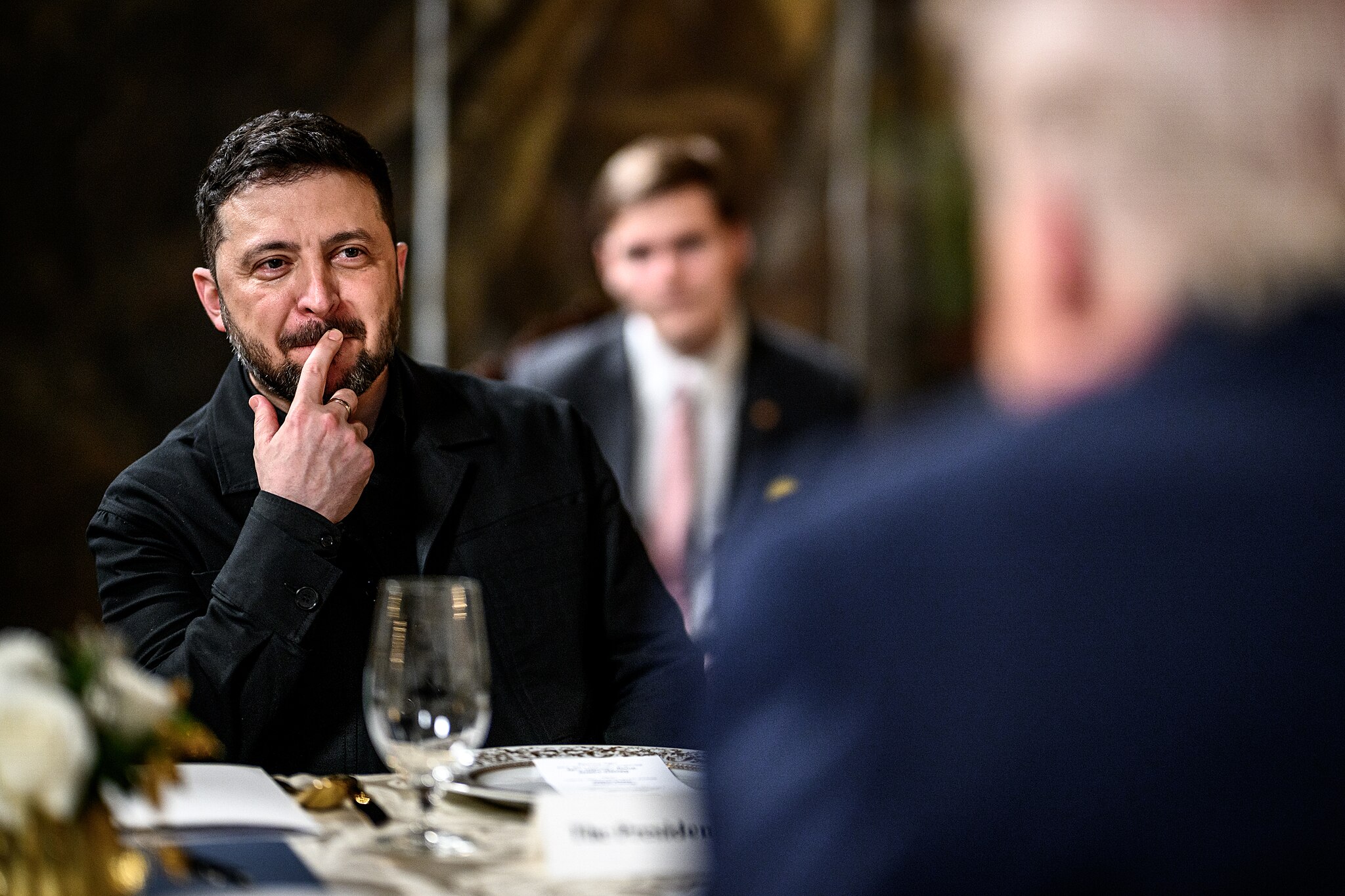
Image: President Donald Trump meets with Ukranian President Volodymyr Zelensky at Mar-a-Lago in Palm Beach, Florida, December 28, 2025. Photo Credit: The White House, Public domain, via Wikimedia Commons.
Related Research
GLAVNOE: The Past Month in Russia, June 2026
Your monthly overview of major recent developments in Russian politics, economy, and society. June 2026 Issue.
The War Has Reached Moscow, and the Russian Propaganda Machine Seems Lost
History shows that Russia rarely changes its behavior out of goodwill. But it has repeatedly changed its calculations when confronted with sufficiently strong and persistent pressure.