
GLAVNOE: The Past Month in Russia, March 2026
Your monthly overview of major recent developments in Russian politics, economy, and society. March 2026 Issue.
The war in Iran: boon or bane for the Kremlin?
After two months of steadily worsening fiscal results triggered by a collapse in oil export revenues that prompted the federal government to announce a 10% cut in the budget’s nonessential expenditures, a faster-than-expected revision of the so-called budget rule (which controls when windfall revenues can be spent), and a growing number of regional governments to review their only recently adopted and already restricted budgets, the US-Israeli war on Iran may have brought the fiscal relief that the Kremlin has hoped for. Relief that can shift the trajectory of Russia’s slowly cascading economic and fiscal crisis, at least temporarily.
In the past month, the Iranian blockade of the Strait of Hormuz and the subsequent rise in global oil prices, from roughly $65–70 per barrel before the conflict to over $100 by mid-March, have created a short-term fiscal windfall for the Kremlin, as the United States announced 30-day sanctions waivers, first specifically for India and then in general on Russian oil loaded before March 12, to stabilize global energy markets. In mid-March, according to estimates published in Financial Times, Russia’s federal budget received an additional $110–160 million windfall revenue per day. Data from the Centre for Research on Energy and Clean Air (CREA) on the first 15 days of the war showed a more modest, but still substantial, figure (a roughly $53 million increase between February and March). In a broader sense, the war in Iran has shown the limits of the United States’ ability to continue its current sanctions regime against Russia while waging war in the Middle East, and it is normalizing the lifting of sanctions independently of the war in Ukraine, which has been Russia’s main objective in its talks with the US government. This is in Moscow’s interest, even though the likely trigger was domestic political considerations for the Trump administration and not a desire to help the Kremlin.
Scratch the surface, however, and the situation is more complex. The war on Iran is also complicating Russia's sectoral crises and leading to dynamics that Moscow neither fully controls nor will necessarily benefit from in the long run. The business daily Kommersant reported that demand for Russian aluminum and fertilizers, two products affected by sanctions, may rise; however, the uncertain situation around the Strait drives up export costs for other, already struggling industries. The war also effectively freezes several Iranian projects by Russian state-owned companies, as well as the development of the North–South Corridor, a transit link connecting Southern Russia with India. Regarding the oil windfalls, the Kremlin is under pressure to strike while the iron is hot, as it is unclear how long the conflict will last.
At the same time, due to liquidity problems in Russia exacerbated by a decision to suspend yuan sales from the National Wealth Fund and the strengthening of the US dollar as a safe asset, the price of imports will likely rise further, increasing the inflationary pressure triggered by higher taxes. The war does not help severe production capacity problems, either. In fact, 75% of small and medium enterprises reported in March that they lacked profits for reinvestment, and capital investment fell 2.3% in 2025.
Governance on autopilot: digital restrictions, utility failures, and the election
All this temporary relief but growing uncertainty comes as the political risks facing the Kremlin before this year’s legislative election are becoming clearer. One of these risks includes widespread dissatisfaction over badly maintained communal infrastructure, often with unclear structures of ownership and responsibility for repairs against the backdrop of steadily rising prices. The winter trends continued recently with several regions suffering accidents, leaving thousands without heating in still-freezing weather. Industry officials acknowledged that heating networks in some Russian cities are 70% worn out, with modernization rates roughly half of what the government’s own plans require. In typical style for Russia’s decentralized crisis management system, the authorities deflected responsibility. In the Irkutsk Region town of Bodaibo, for instance, where a January pipeline rupture left residents without heat for weeks (and was still not fully fixed as of early March), the head of the municipality was arrested and charged. In his yearly report to the Duma on the government’s work, Prime Minister Mishustin said that utility tariff overshoot, which residents of several regions complained about, was the fault of regional regulators misusing their authority. He supported giving the Federal Anti-Monopoly Service (FAS) power to override regional tariff-setting. Earlier, the FAS found no evidence of excess tariff hikes in spite of the complaints. Meanwhile, the government has shown no willingness to increase funds allocated to utility network repairs. Regional budgets, which stand to benefit only indirectly from any oil windfall due to the Russian tax system, will certainly not be able to spend more money on repairs.
Another major rising risk factor seems to be the impact of a sudden tightening of digital restrictions. Following severe mobile internet outages across the country, including in Moscow, and the introduction of a “white list” of state-controlled or state-approved online services, the accessibility of Telegram dropped to roughly 80% across the country. Telegram is Russia’s most popular messaging and news-sharing service that is also a major platform for advertisers and an important tool for businesses. Sources from both the presidential administration and the Security Council have reportedly confirmed a full Telegram ban scheduled for April 1, with the authorities ramping up their attempts to force Russians to use the state-linked messenger “MAX.” As of March, 70% of the channels on MAX have been created by government bodies, with users reporting that they were being forcibly subscribed to channels sharing propagandistic content. The response to the increasingly severe outages and the Telegram ban was widespread annoyance: protests were organized in major cities, such as Novosibirsk, Irkutsk, Khabarovsk, albeit with most municipal authorities refusing to sanction the demonstrations. Once again, the Kremlin’s securitized political machinery seems to be moving with inertia, as concerns over a lack of total control over information flows and organizing overwrite fears of a backlash against internet restrictions, even though regional officials have also quietly warned that they had expended considerable resources on building an audience on the app. In a notable case, Andrei Svintsov, a deputy of the Liberal Democratic Party (LDPR), was expelled from the party due to his full-throated support for the Telegram ban. This demonstrated that, even though the LDPR did not explicitly challenge the ban and is usually loyal to the Kremlin’s policies, the party’s leaders consider the issue a massive political liability with Svintsov’s actions seen as an attempt to curry favor with the Kremlin, potentially at their expense.
It is not surprising that federal officials seemed to moderate their expectations from the September election. In late February, the Kremlin reportedly adjusted its turnout expectation from 55% to 50%, effectively telling regional officials and power brokers to go easy on the mobilization of voters. The politically fraught issue of bringing decorated war participants into government bodies may also be revised. Government sources told the Vyorstka news site that the presidential administration no longer considers it a priority to bring a large cohort of war participants into the federal legislature, despite earlier pledges, due to concerns that the authorities are not always fully in control of the consequences, as some prior examples have shown.
The Tsalikov arrest: a sign of things to come?
March has also brought elite friction into focus with the arrest of Ruslan Tsalikov, a former deputy defense minister. It is worth noting that this is happening against the backdrop of still-intense law enforcement activity against various high-ranking regional officials, typically overseeing corruption-prone sectors such as construction or utilities. Tsalikov—the fourth former deputy defense minister to be detained since 2024—was charged with organization of a criminal enterprise, embezzlement of budget funds, money laundering, and bribery for a total of 15 counts. The political significance of the arrest is that Tsalikov has been a longtime loyal associate of Sergey Shoigu, the secretary of the Security Council, who led the Defense Ministry until 2024. Shoigu’s transfer to the Security Council had been seen as an honorable discharge for a politician who had built his federal career and popularity before Vladimir Putin’s ascension to power, expertly navigated the muddy waters of federal politics, and built a personal rapport with the president. Once the attention of the Kremlin turned to endemic corruption at the Defense Ministry and the military failures of the war in Ukraine, however, Shoigu essentially lost the ability to defend his allies, even as he has not faced major legal consequences himself. Tsalikov’s story is especially notable: after Shoigu’s dismissal in June 2024, he attempted to secure protection from criminal responsibility by becoming a deputy in the Supreme Khural (parliament) of Tuva—Shoigu’s home republic—with the explicit intent of being elevated to the Federation Council, the upper chamber of Russia’s legislature. This effort was thwarted, likely by the Kremlin. Tsalikov was forced to testify against Timur Ivanov, another former Shoigu deputy, who was eventually sentenced to 13 years in prison. The fact that even this was insufficient to shield Tsalikov from prosecution is ominous for Shoigu, one of whose key aides was also recently dismissed from the Security Council. Political analyst Mikhail Komin, who does research on the Defense Ministry, suggested that Shoigu’s future itself may hinge on whether and for how long Putin is able and willing to block prosecutorial action against him. His fall would be one of the most significant manifestations of domestic political turbulence triggered by the war.
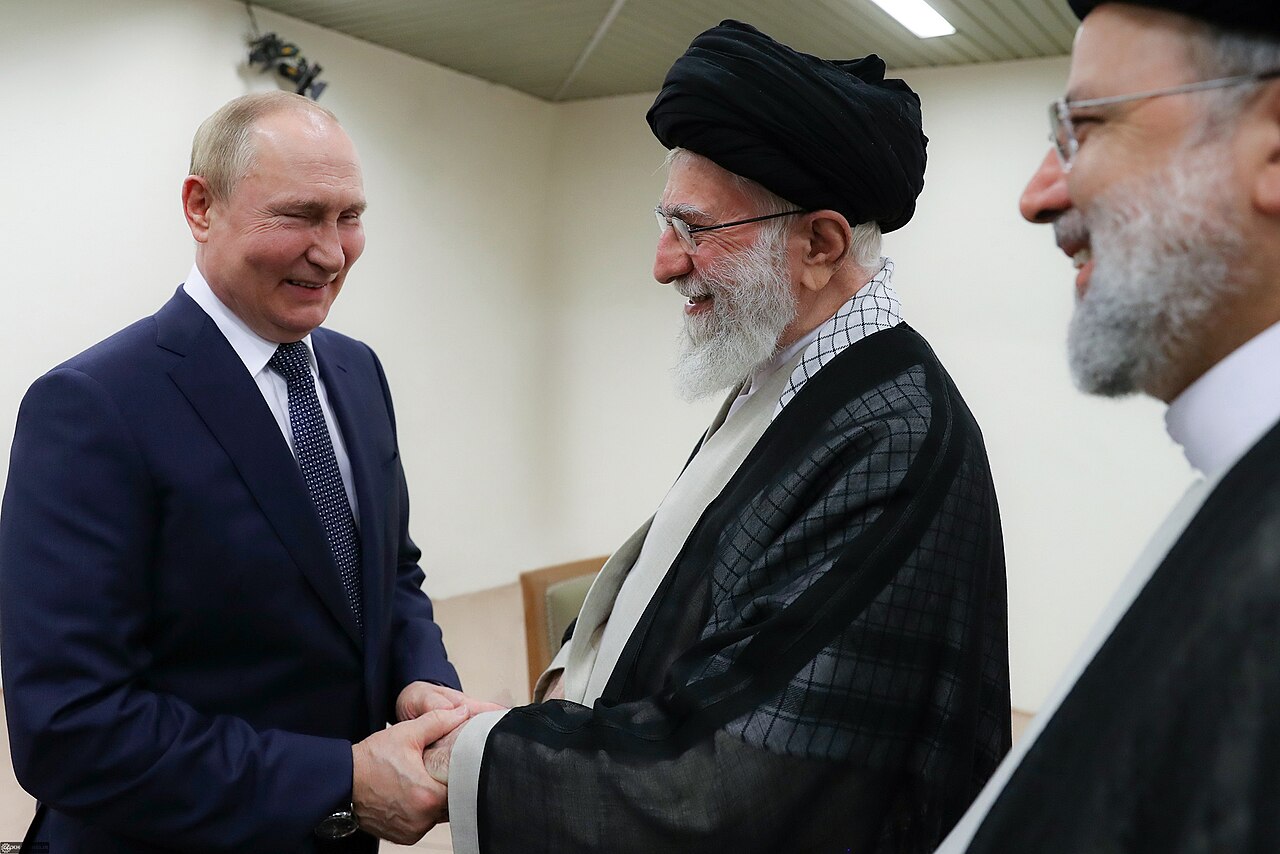
Featured Image: Meeting of Russian President Vladimir Putin with Iran's late supreme leader, Ayatollah Khamenei, July 19, 2022
Image Credit: Khamenei.ir, CC BY 4.0 <https://creativecommons.org/licenses/by/4.0>, via Wikimedia Commons
Related Research
GLAVNOE: The Past Month in Russia, June 2026
Your monthly overview of major recent developments in Russian politics, economy, and society. June 2026 Issue.
The War Has Reached Moscow, and the Russian Propaganda Machine Seems Lost
History shows that Russia rarely changes its behavior out of goodwill. But it has repeatedly changed its calculations when confronted with sufficiently strong and persistent pressure.