
Greenland and US Arctic Security: What’s Really at Risk
President Donald Trump and his acolytes have argued that the US needs to absorb the island of Greenland for its raw materials, to ensure US security, and to prevent aggressive powers like China and Russia from taking it first.
In January, Trump claimed that Russian and Chinese ships are “all over the place” near Greenland and that the US needs to “own” Greenland to prevent the Chinese and Russians from seizing control. Trump also threatened that the US will gain control of Greenland “the easy way” or “the hard way”because the US can’t have Russia or China as a neighbor, implying that US military force is an option. Trump later publicly ruled out the use of military force but insisted only the US can defend the island. Earlier, Carla Sands, Trump’s former Ambassador to Denmark, claimed that Russia and China are both seeking footholds on Greenland and that Denmark, which has sovereignty over the island, lacks the resources to defend it.
There is no question that access to Greenland is important to the United States’ security. Greenland borders the Norwegian Sea, an area critical to Russian naval and strategic bomber operations, and its southern coast constitutes part of the famous Greenland-Iceland-UK Gap (GIUK Gap) through which Russian naval vessels enter and exit the Atlantic Ocean. The US maintains an important base at Pituffik that is critical for early warning of strategic bomber and intercontinental ballistic missile attack against North America as well as space operations. For decades, the US has worked with Denmark and the people of Greenland to maintain access and a presence on the island. In 1951, Denmark and the US forged a formal agreement codifying US access, an agreement that was amended in 2004. However, the threat that Russia or China could or would seize control of the island if the US doesn’t make the entire landmass a US territory or state is vastly overstated. By contrast, rhetoric about a hostile US takeover of the island could dramatically reduce American influence and power in the Arctic broadly while enhancing both Russia’s and China’s status.
Russian Or Chinese Invasions Are Unlikely
Greenland is a difficult military environment. The island is huge, about three times the size of the US state of Texas. Close to 80 percent of the island is covered by glaciers and high mountains ring much of the rugged coastline. The long polar winter means that ice covers the seas around much of the island for significant portions of the year, particularly in the north. Climate change is reducing ice coverage on both land and sea, but cold and ice will remain major factors in the near term. Due to the climate and topography of the island, only a narrow strip of land along the island’s coastline is habitable and only about 57 thousand people live there, with most of those in the south and west. The island’s infrastructure is limited. For example, there are few roads; most transit is done by air, sea, or dog sled.
The size and location of the island, its topography, and the climate would make a major invasion difficult. Instead, if Russia or China wanted to take control of a portion of Greenland militarily, their forces would probably try to seize an airfield or port in the southern portion of the island and attempt to expand control from there. Such an invasion would probably begin with the covert deployment of special operations forces for reconnaissance and even preliminary attacks, but at some point, a large airborne or amphibious assault force would need to attempt an insertion to occupy the chosen area. It is unlikely that either Russian or Chinese amphibious forces could achieve total surprise in carrying out this operation as their ships would have to travel vast distances and could be spotted, tracked, and potentially interdicted as they approached the island. An aerial assault would probably have a better chance of achieving success as it would be more sudden, but the aircraft would have to travel far and run the risk of interdiction on the way.
Even if Russian or Chinese forces were somehow successful in carrying out a surprise insertion onto Greenland, those countries would then face the challenge of holding and even expanding that lodgment in the face of US and NATO pressure. Denmark is a NATO member state, so NATO’s Article Five stipulations and Allied forces would come into play. The conflict would probably quickly escalate, making the logic of seizing a portion of Greenland questionable.
If, for some reason, neither Russia nor China feared a NATO response, both would face the challenge of protecting and supplying any forces in Greenland, an island with little food and fuel sources of its own. China has no military bases in the Atlantic or Arctic regions from which to conduct support operations, and would thus need to rely on its Navy and a supply line that stretched half-way around the world. That supply line would be open to interdiction at various places, including narrow straits or points close to land that would make interdiction much easier. The challenge of conducting and securing supply convoys would be extremely costly and take many naval assets. That diversion would almost certainly reduce naval power available for any invasion of Taiwan, which is likely a much more critical strategic priority for China than Greenland. A major Chinese military operation to take even a portion of Greenland is thus highly unlikely.
Russia has territory and bases in the Arctic and the Baltic, but Russian air and naval forces would still have to travel thousands of nautical miles to reach any lodgment on the island. Those air and sea routes would be within easy range of US or European forces operating from Greenland, Norway, the Baltic, Iceland, and the UK that would be capable of interdicting them. Given that NATO’s collective air and naval forces probably outnumber Russia’s and Russia continues to dedicate most of its military forces to achieving its goals in Ukraine, a major unilateral Russian effort to seize territory on Greenland is highly unlikely.
Russia and China could conceivably cooperate to seize portions of Greenland. President Trump and others have pointed frequently to increased cooperation between these two powers in the Arctic region. However most of that cooperation is currently in the economic sphere and focused on extracting hydrocarbons from Russian territory for shipment to Asian markets. The military cooperation that does occur between the two usually takes place south of the Arctic Circle in the Pacific Ocean and Bering Sea, nowhere close to Greenland. Individual Chinese scientific “research” ships do frequently sail north through the Bering Strait to conduct operations in upper latitudes of the Arctic Ocean near the North Pole. One of these vessels sailed through international waters between Greenland and Norway’s Svalbard Archipelago in 2021, but operations that close to Greenland are rare. Regardless of current conditions, any future cooperative Chinese and Russian military effort to take a portion of Greenland would face the same challenges as a unilateral one.
More Plausible Threats
There are more plausible Russian and Chinese threats to Greenland, particularly if either country feels threatened by an increased US military presence on the island. For example, sabotage operations of critical infrastructure are a possibility based on Russian activity in parts of Europe. Western analysts have pointed out that critical undersea cables between Iceland, Canada, and Greenland are vulnerable to attack and both China and Russia are believed to have that capability. A growing number of Russian naval vessels carry long-range precision-guided munitions that can strike ground targets, and Russia could presumably use these to target US military infrastructure in Greenland in the event of war. None of these scenarios would enable China or Russia to seize and hold territory on Greenland; they would instead disrupt US and Allied attempts to secure the island and could probably be deterred using proactive defensive measures.
It’s far more likely that Russia and China would attempt to use non-military tools to obtain resources or increase influence in Greenland rather than militarily seizing territory. Even that faces challenges. Chinese companies, for example, have already attempted to invest in several mining projects in Greenland with little success. Most of these projects failed or were abandoned probably due to the high cost of operations in such a remote area. One western analyst believes the Chinese realized these projects required costly infrastructure to become feasible and that icy seas would raise the cost of shipping, making them uncompetitive. European and American concern over Chinese influence on Greenland also likely played a role in reduced Chinese efforts.
Russia, which lacks the economic clout of China and has other investment priorities, probably wants political influence in Greenland as it pursues a leading geopolitical role in the Arctic. For years, Russia has used public messaging to portray itself as the protector of peace and prosperity in the Arctic while painting the US as an aggressor bent on turning the area into a zone of conflict. In January, the Russian Foreign Ministry said that neither Russia nor China has territorial ambitions in Greenland, and that the US is making up this threat to justify its own aggressive intentions towards the island. In March 2025, Russian President Vladimir Putin said in a speech that Russia is open to peaceful cooperation with all states in the Arctic, that the US discussion of controlling Greenland is “serious,” and that NATO countries wish to use the Arctic as a springboard for conflict. These themes may resonate more with the people of Greenland as US rhetoric about control of the island heats up.
The Real Risk to U.S. Security in the Arctic: The Loss of Allies
There are real risks to US security interests across the Arctic from both Russia and China individually and together. Since the Cold War, the shortest path to North America for Russian intercontinental ballistic missiles, submarine launched ballistic missiles, and strategic bombers has been through the Arctic. Russia bases most of its ballistic missile submarines in the Arctic and frequently operates strategic bombers in Arctic airspace, including near Alaska. Russian ships and submarines periodically leave their Arctic bases to enter the Atlantic, posing a potential threat to US shipping lanes and the US homeland. United States Army Captain Mark Vicik argues that increased Sino-Russia cooperation in the Arctic will probably lead to greater Chinese civilian and military presence in the region, and that China’s tendency to “blend civilian assets and military capabilities” increases the potential threat to America’s Arctic interests. Indian Rear Admiral Monty Khanna believes that China ultimately wants to deploy its own ballistic missile submarines into the Arctic.
To counter these threats and secure its broader Arctic interests, the US needs the cooperation of its traditional NATO partners, especially those with territory in the Arctic: Canada, Denmark (including Greenland), Finland, Iceland, Norway, and Sweden. For example, the US and Canada jointly operate the North American Aerospace Command (NORAD) to defend North America from potential ballistic missile and bomber attacks coming through Arctic airspace. NORAD depends heavily on 49 radars stationed in Canada’s northern Arctic region for this purpose. The US uses bases in Norway and Iceland and cooperates closely with its NATO partners for anti-submarine warfare operations in the Norwegian Sea and the Atlantic. As a result of a new agreement signed in 2021, the US has expanded access to multiple military bases and operating areas in Norway that American forces can use for these purposes. Canada, Denmark, and Norway also conduct Arctic military training and operations, often in conjunction with the US. Those countries are also spending billions of dollars to buy American-made equipment such as the F-35 fighter and P-8 maritime patrol aircraft.
Given the virulent objections of the Greenlanders and other European powers to US rhetoric and threats to both Greenland and Canada, that cooperation could be at risk. In time, the US could see far less operational collaboration with its Arctic NATO Allies, decreasing combined combat power and intelligence collection. Should the Allies fear US intentions on their territory, they might reduce American military access to their bases, steps that would vastly decrease the US ability to deter Russia in the Arctic and potentially China as well. Finally, those Allies may decide to back out of the purchase of American-made equipment, hurting US industry. This certainly won’t make America great, just alone in a more dangerous world. Both China and Russia, on the other hand, would celebrate.
Disclaimer: All statements of fact, opinion, or analysis expressed are those of the author and do not reflect the official positions or views of the US Government. Nothing in the contents should be construed as asserting or implying US Government authentication of information or endorsement of the author's views.
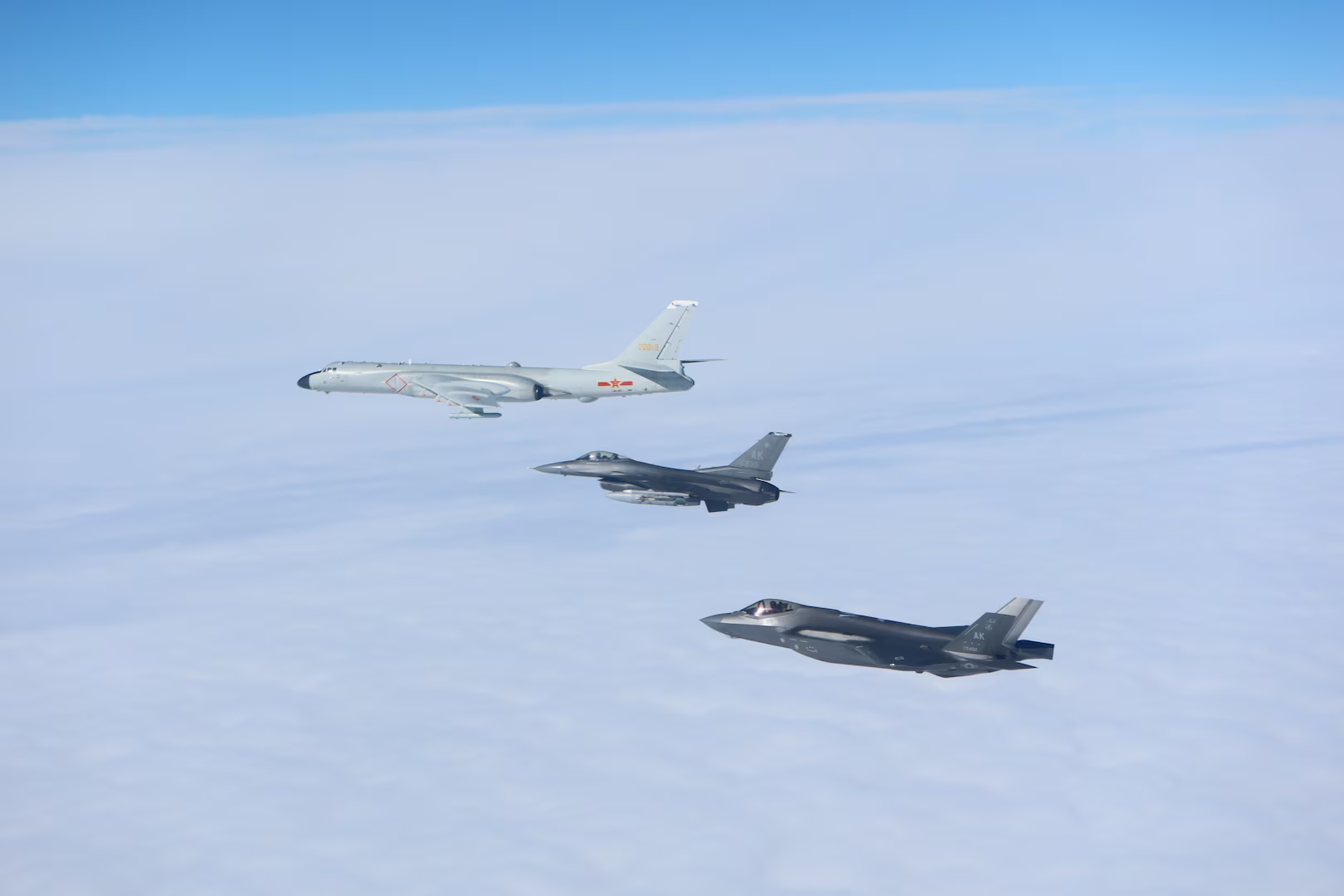
Image: NORAD detected, tracked, and intercepted two Russian TU-95 and two PRC H-6 military aircraft operating in the Alaska Air Defense Identification Zone (ADIZ) on July 24, 2024. NORAD fighter jets from the United States and Canada conducted the intercept. Image Credit: NORAD.mil at https://www.norad.mil/Newsroom/Press-Releases/Article/3849184/norad-detects-tracks-and-intercepts-russian-and-prc-aircraft-operating-in-the-a/