
How Uzbekistan’s Plastics Gamble Offers Insights Into the Country and Region’s Future
As investments and technology continue to pour into deep processing gas, Uzbekistan is increasingly poised to be a regional leader in production capabilities. Watching how Tashkent navigates these challenges will reveal clues about the country’s direction for years to come.
In September 2025, Uzbekistan announced a partnership with American gas major Air Products to accelerate construction of the Gas Chemical Complex MTO Central Asia (GCC MTO) in Karakol, with costs ranging between $3 and $5 billion. The facility is one of two flagship Methane-to-Olefin (MTO) complexes designed to produce plastic resins, particularly polyethylene terephthalate (PET) and polypropylene (PP). Alongside several smaller facilities like the CAMCE PVC complex or ArkChemical plant, the deal reflects Tashkent’s seriousness about developing its gas deep-processing industry, particularly into plastics.
This push, however, comes at a difficult time for the global plastics market, which is suffering from severe oversupply and depressed margins. With producers in Europe and Southeast Asia shuttering facilities, the recent deal with Air Products signals that Uzbekistan is intent on forging forward with its new plastics play. Following how Uzbekistan deals with the unique challenges it will face to enter this market could offer broader lessons about the country’s geopolitical and economic orientation.
Why Plastics? Why Now?
Uzbekistan has a chronic dependency on natural gas, which represents 80% of its energy mix, fuels the majority of vehicles, and is integral to the country’s manufacturing base. Years of heavy subsidies and poor maintenance have led to huge consumption and high inefficiency, with between 7% and 15% of gas being lost in transit, while the country ranks amongst the most energy intensive per-capita globally. Though still home to between 1.1 and 1.8tcm of proven reserves, much of this gas remains inaccessible due to technological and infrastructural constraints. Today, 85% of Uzbekistan’s existing fields are exhausted, leading to reoccurring winter shortages that have rocked daily life for the past four years.
Aspects of Tashkent’s response have included importing gas from Turkmenistan and Russia, adjusting subsidies, temporarily ceasing gas exports (only increase them in 2024), and striking a deal to explore for gasin Afghanistan. The cornerstone of Tashkent’s new gas policy, however, is a long-standing commitment to developing deep-processing capability, especially polymer production.
The appeal is understandable, the value-add of base resins compared to raw gas is enormous. Since 2019, Tashkent has announced dozens of chemical industry projects, including the creation of industrial parks and free economic zones (FEZ) designed to attract foreign investment. The scale of the projects is significant. The GCC MTO complex alone is expected to consume roughly 1.3 bcm of gas and produce 1.1 million tons of polymers annually. The second MTO plant in Khorezm is expected to produce 2.0-2.4 million tons of assorted polymers.
The plastics gamble bodes well for the Middle Corridor
Uzbekistan’s gambit comes amidst prolonged turmoil in today’s plastics markets: an oversupply glut that has rocked the industry. Between 2020 and 2025, global ethylene supply increased by 40 million tons, whilst demand only rose by 27 million tons. Profit margins for some plastics, including polyethylene, have been negative since 2022, while more than a quarter of ethylene processing faces risk of closure by 2030. Some analysts predict market normalization only in the early 2030s. Given these challenges, competitive and reliable market access will be key.
Officials predict 50-70% of outputted polymers will go towards domestic use, with the rest primarily exported to Turkey and China. Uzbekistan’s manufacturing industry, dominated by automotives, machinery and textiles, relies on plastics, particularly as rug and textile manufacturers transition to synthetic fibers. The GCC MTO hasreportedly secured contracts for 60% of expected production. As the economy evolves around plastics, Uzbekistan predicts an 80% increase in polymer consumption by 2030. Nonetheless, exports will be essential to success.
The obvious export markets for Uzbekistan are nearby China and Russia, both challenging. In 2024, Russia announced plans to increase production by 4 million tons by 2030. Sanctions have bolstered domestic supply, while the share of domestic plastics continues to rise. China, highlighted originally by Uzbekistani officials as a target for exports, represents 70% of increased global polymer production in the last 5 years, and is now near self-sufficient in most major resins except polyethylene.
Prices for Uzbekistan’s new polymers have yet to be disclosed, though the primary technology is Chinese,which produces some of the cheapest plastics globally. The new plants will be “backwardly integrated” (connected directly to upstream feedstock). Combined with cheap gas and other subsidies, Uzbekistan’s polymers will likely be competitively priced. Still, given saturated and competitive markets, Uzbekistan could struggle to export to Russia and China. Although not highlighted officially as a target, as interest in an Afghan corridor increases, it’s worth noting that India now sports a similarly competitive market. Statements designated China as a target were given several years ago, and may not have accounted for China’s current production, Russian sanctions, and market turmoil.
With high energy costs, European producers are struggling under the global supply glut, with several plants having closed. Here, Uzbekistan’s plastics will undoubtedly find a friendlier market. The average spot price for polypropylene in Europe in November 2025 was 51% higher than North East Asia, while PET was 61% more expensive.
The trouble is logistics. Uzbekistan must avoid Iran and Russia to access European markets, leaving only the nascent Middle Corridor route, across the Caspian Sea, Caucasus, and into Turkey. Despite billions in investments and significant improvements, many experts continue to voice concerns over its viability, citing high costs, bureaucratic complexities, and overloaded port and rail infrastructure. Tashkent’s doubling down on plastics production, could be interpreted as an implicit bet on the corridor’s increasing viability despite ongoing skepticism.
Gas production could one day resurge, exports likely won’t
Uzbekistan has embarked upon several projects to boost gas production, including a deal to access fields in Afghanistan and revitalized exploration efforts. Uzbekistan’s gas crisis, however, stems from aging infrastructure and poor technology, with much of its major reserves inaccessible due to depth or low pressure. As global engagement with Central Asia increases, bringing investment and more advanced technologies,including horizontal drilling and deeper wells, Uzbekistan may soon see its declining production stabilize or even slowly increase.
In recent years Uzbekistan has halted and restarted gas exports. Amidst pledges to end gas exports by 2025 and declining production, exports rose by 18.4% in 2024, continuing in 2025, prompting questions about future export policy. These increases should not be read as a policy shift. Between 2019 and 2023 exports decreased by nearly 86%, with 2024-2025 levels remaining relatively small compared to pre gas-crisis times. Many of these changes may be motivated by contractual and political considerations with China.
Uzbekistan was once a significant exporter of gas. Even if production ramps up, major exports are unlikely to return. The production crisis has led to an intense energy deficit filled by imports from Russia and Turkmenistan. By 2035, domestic consumption is expected to jump by 60%, in-part driven by major gas processing facilities. These projections likely did not include the added energy burden of AI and data centers, of which Uzbekistan has announced ambitious projects. The three largest gas processing projects: the two MTO plants and the recently launched Oltin Yo’l GTL plant, will likely consume nearly 7 bcm alone. As both plastics plants near completion, a future leap in domestic consumption is near guaranteed. With it, the prospects of Uzbekistan returning to significant gas exports fall further.
The plastics gamble may clash with pushes to liberalize the energy market
As Tashkent works to attract foreign investment and join the WTO, it has pledged to liberalize the economy, with significant progress made. Historically, gas has been heavily subsidized, with some of the lowest wholesale energy prices globally. In 2020 the IEA estimated Tashkent spends 6.6% of its GDP on energy subsidies. Since 2024, subsidies have gradually lowered, with industrial gas sold at $0.17 per cubic meter as of May 2025, still significantly below global rates. Research indicates gas is sold to consumers for half of its production cost.
Beyond subsidized feedstock, Uzbekistan’s new polymer plants and surrounding FEZs will benefit from generous incentives: 50% reduced corporate taxes for 3 years and permanent exemptions on land, water, and property taxes, among other perks. The few privately-operated processing plants are owned by Saneg, which also controls upstream feedstock. Though Saneg is subject to the same pricing regime as state-owned Uzbekneftgaz, it is unclear how internal transfers will be managed.
Liberalization of the energy industry has been notably slow. Though Uzbekistan announced plans to have gas subsidies managed by an “independent market regulator” by 2025, this has yet to materialize. While an independent body has been established, EMDRA, it currently only oversees electricity. Though officials once held that gas subsidies would be phased out by 2028, an April 2025 action plan asserts that subsidies may persist as long as 2035, partially under the mandate to support the “expansion, modernization and diversification of production capabilities.”
How Uzbekistan’s plastics production will interface with a liberalized energy market remains unclear. Several energy economists have asserted that a push into polymers will not be viable without substantial subsidies, particularly given global market turmoil and the notable added logistics costs. Amidst a degrading gas network, with up to 15% losses in transportation, costly upgrades, and declining well pressure, the true cost of gas may climb near term, which in a liberalized economy, could have serious consequences for the budding industry.
On the other hand, failure to liberalize could be risky beyond deterring potential foreign investors, particularly as ordinary Uzbekistanis suffer cold winters, rationing, and pollution. The liberalization of Uzbekistan’s gas industry is widely viewed as key to both curbing inefficient usage and funding much needed repairs to the system. Meanwhile, rolling energy crises have driven people to burn coal, wood, trash and whatever else in recent winters, making Tashkent one of the most polluted cities in the world. Combined with severe water mismanagement, concerns over air quality have led to rising public interest in broader environmental protections, which may also increasingly shape industrial policy.
The dilemma over gas tariff liberalization that Uzbekistan now faces could have widespread implications as foreign actors consider investment, particularly in Uzbekistan’s natural resources. The unclear future relationship between the state-managed gas economy and Uzbekistan’s plastics industry highlights how the project is deeply intertwined with political and geopolitical considerations, just like the changing exports policy or accessing western-bound trade routes. As deadlines approach and investments and technology continue to pour into deep processing gas, Uzbekistan is increasingly poised to be a regional leader in production capabilities. Watching how Tashkent navigates these challenges will reveal clues about the country’s direction for years to come.
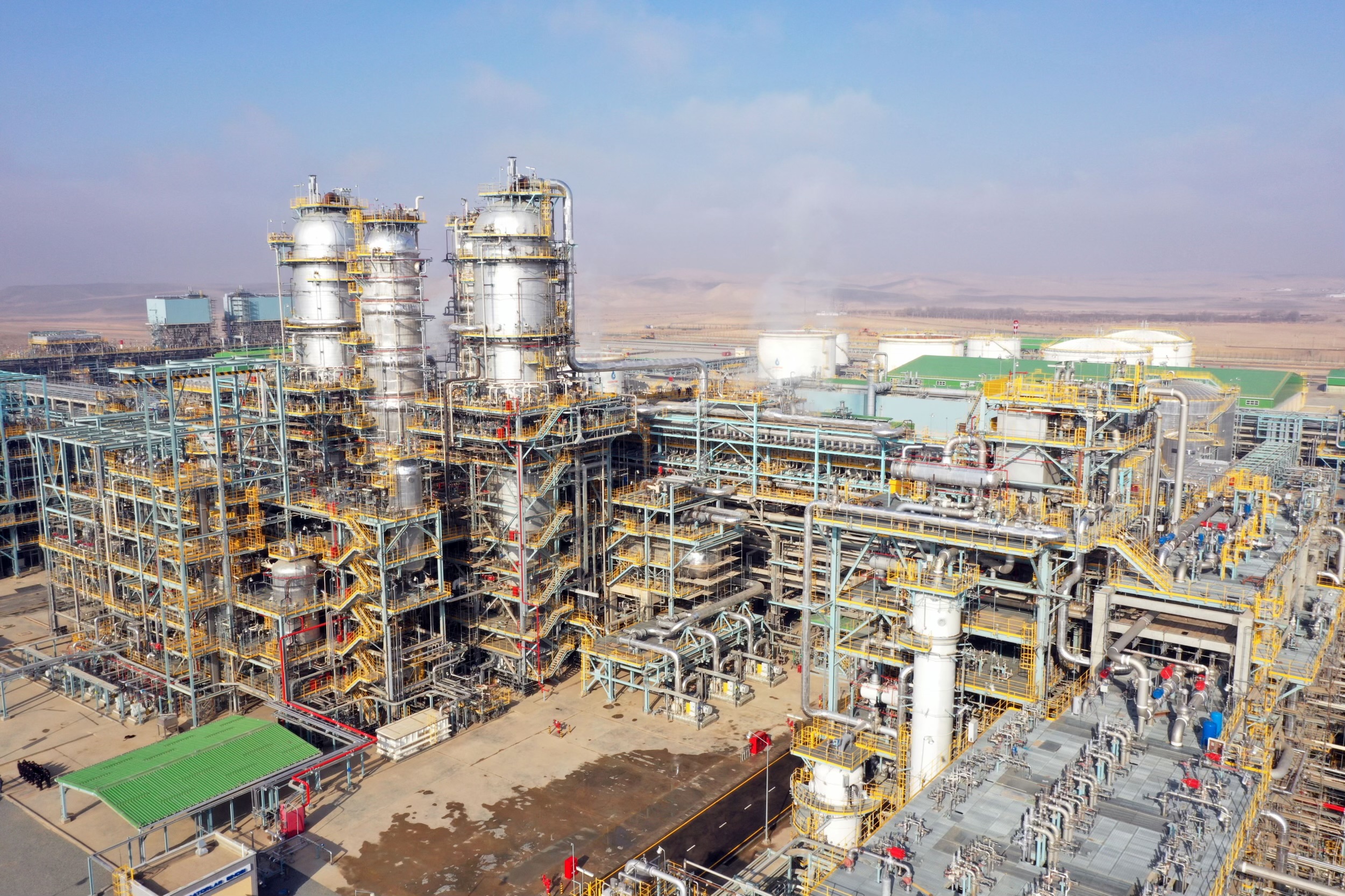
Image: Gas-To-Liquid plant in Qashqadaryo, Uzbekistan. Image Credit: Kinkz27, CC BY-SA 4.0 <https://creativecommons.org/licenses/by-sa/4.0>, via Wikimedia Commons