
The "Critical Infrastructure" Gambit: How the US is Securing the Balkans
The Western Balkans’ geographical proximity to Ukraine, coupled with its cost-effective labor force and existing logistics networks, positions the region as an ideal manufacturing hub for the Ukrainian war effort.
For decades, the sprawling munitions plants of the Balkans were viewed as rusting relics of a Cold War past—monuments to a Titoist or Soviet doctrine of self-reliance that the modern world had outgrown. But as the war in Ukraine enters its fourth year, the "rust" is being polished into a strategic edge. From the valley of Vogošća in Bosnia to the industrial hubs of Bulgaria, the Balkans are no longer just a peripheral security concern; they have become the indispensable "back office" of the Ukrainian war effort. While Western Europe struggles with the red tape of industrial scaling, the Balkans are proving that the path to Kyiv’s victory may very well run through the revitalized factories of Southeast Europe.
The EU’s 2025 White Paper sets a daunting goal of producing 2 million artillery rounds annually by 2030. The Union’s recent struggle to meet even half that target proves that internal production alone will not suffice. This is where the Balkans’ unique industrial legacy becomes a "Goldilocks" solution. With over 200 defense firms, the region possesses a robust, cost-effective infrastructure capable of producing both NATO and Soviet-standard equipment. Bosnia and Herzegovina’s ability to churn out half a million shells annually is proof of a capacity that can be rapidly scaled with European investment.
During my recent closed door briefing in the sterile corridors of the Bundestag, I was baffled to find out just to what extent Germany was interested in the armaments factories of the Balkans - especially in Sarajevo. Bosnia and Herzegovina and Serbia remain the cornerstones of regional defense manufacturing in specialized munitions output. Major players—including Bosnia’s Igman, Pretis, and Binas, and Serbia’s Yugoimport and Krušik—anchor a market that is uniquely positioned to support Ukraine due to their dual mastery of NATO and Soviet-standard weaponry. While both Sarajevo and Belgrade officially restrict arms sales to active conflict zones, these barriers have proven porous. Evidence from late 2025 confirms that significant quantities of Balkan-made mortar rounds and artillery shells continue to reach the Ukrainian front via 'third-party' conduits in Turkey, Czechia, and Slovakia, often bypassing formal end-user restrictions through discrete commercial re-exports.
The West has a prime opportunity to expand Communist-era arms production in the Balkans, filling a critical gap for a Ukrainian military that is already proficient with these platforms. By outsourcing production to SEE nations, the US and major European powers can maintain a steady flow of aid while insulating their long-term support for Kyiv from the volatility of domestic political cycles.
Serious projects are already being operationalized
According to my high-level sources within the US State Department and the Department of War (DoW), Washington is preparing a massive expansion of its industrial footprint in Bosnia and Herzegovina. Regulus Global—which has already accelerated its modernization phase at the Pretis facility—is set to spearhead this American investment surge. Regulus Global has proposed a $100 million three-year investment (2026–2028) to modernize the Bosnian defense manufacturer Pretis. It currently holds a 41.35% minority stake alongside the Federation of BiH government (51%), and aims to scale production to one million artillery shells annually. The plan focuses on integrating advanced digital tools and blockchain traceability to meet NATO standards, positioning Bosnia as a key regional defense hub within international supply chains. The objective is to transform Bosnia into a critical node in the Western supply chain, capable of mass-producing 155mm and 152mm shells, advanced shell castings, and modular charges. This move signals a long-term US commitment to using the Federation’s industrial base to stabilize European security and replenish allied stockpiles.
Strategic decision makers in Washington have recognized that while Bosnia’s front door to NATO remains locked by veto wielding hardline Republic of Srpska leaders such as Milorad Dodik, the back door—through the defense industry—is wide open. By embedding Bosnia into the US military supply chain and providing 'Critical Infrastructure' status to key factories, the DoW is essentially integrating Bosnia’s industrial output into the Western security architecture, neutralizing the impact of Russian-backed obstructionism. Under a possible Department of War (DoW) "Critical Infrastructure" designation, these plants could gain a level of protection that is functionally equivalent to a NATO base, but without the political red tape. When a factory is declared Critical Infrastructure Facilities, any attempt at sabotage (a frequent Russian tactic in the Balkans) is no longer an internal Bosnian police matter—it is a threat to US national security and would trigger a direct response from the US European Command (EUCOM) or specialized DoW security assets.
Apart from American companies, other NATO heavyweights are following suit. German defense leader Rheinmetall is pouring over €1.5bn into Romania and Bulgaria to ramp up European munitions production. These sites will focus on gunpowder and NATO-standard 155mm shells, signaling a definitive move away from Soviet-era tech toward Western-caliber weaponry in response to regional demand.
Türkiye too is rapidly positioning itself as a defense architect of the Balkans. The latest move—a partnership between state-owned MKE and North Macedonia’s ATS Group—will see the construction of a critical gunpowder factory supported by the government in Skopje. Türkiye’s state-owned manufacturer MKE has also finalized an agreement to establish a turnkey ammunition production facility in Kosovo, marking a significant deepening of defense ties between Ankara and Pristina.
Yet, an arsenal is useless if its gates are locked
The geography of the Western Balkans makes them the "Balkan Bridge" between the Mediterranean and the Ukrainian front line. Strategic autonomy requires military mobility—the ability to move troops and hardware across the continent without bureaucratic friction or crumbling bridges. It is a strategic failure that while the EU has billions for mobility, its "southern route" remains neglected. Integrating the region into the single market and upgrading its infrastructure is not a charitable act for candidate states; it is a survival requirement for a Union that cannot afford logistical bottlenecks in its own backyard.
Beyond munitions, Washington is moving aggressively to sever the last of the region’s umbilical cords to Moscow: energy. In a move that blends high-stakes geopolitics with unapologetic 'America First' commercialism, the US has secured an agreement to have AAFS Infrastructure and Energy—a private firm led by Joseph Flynn, brother of former National Security Adviser Michael Flynn—build and operate the Southern Interconnection gas pipeline. This $200 million project will connect Bosnia to a liquefied natural gas (LNG) terminal on Croatia’s Adriatic coast, effectively ending the country’s 100% reliance on Russian gas via TurkStream by 2028.
By bypassing the corrupt political bickering of local state-owned utilities and handing a 30-year concession to a US firm, the Department of War and the State Department are ensuring that the energy powering Bosnia's defense factories is as Western as the shells they produce. It is a clear signal that in the Balkans, American energy dominance is the new guarantor of European security.
The Western Balkans’ geographical proximity to Ukraine, coupled with its cost-effective labor force and existing logistics networks, positions the region as an ideal manufacturing hub for the Ukrainian war effort. By leveraging the European Peace Facility (EPF) and the SAFE initiative, which allows candidate countries to participate in joint procurement, the West can secure a sustainable munitions supply for Kyiv.
This partnership would not only bolster regional security and combat Russian malign influence but also foster long-term economic stability and deeper bilateral ties between Ukraine and the Balkan states.
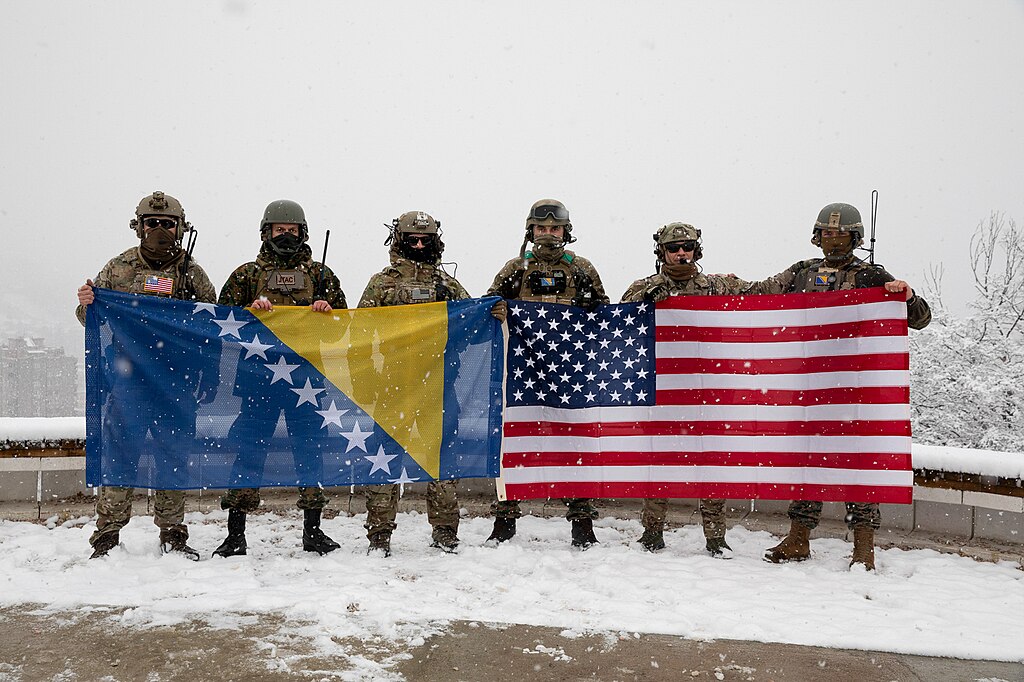
Image: U.S. Special Operations Command Europe soldiers and Armed Forces of Bosnia and Herzegovina (BiH) joint terminal attack controllers stand in unity during a bilateral training event in BiH, Jan. 8, 2024. This bilateral training is an example of advanced military-to-military cooperation that contributes to peace and security in the Western Balkans and throughout Europe. (U.S Army photo by Sgt. Alejandro Lucero). Image Credit: Sgt. Alejandro Lucero, Public domain, via Wikimedia Commons.