
The US-Iran War and the Future of TRIPP in the South Caucasus
Any long-term U.S. strategy toward Tehran must recognize that the stakes extend well beyond the Arab world or the Persian Gulf. They also encompass the geopolitical future of the South Caucasus and the broader contest over power, influence, and connectivity across Eurasia.
The ongoing war in Iran has profoundly disrupted the Middle East economically, politically and strategically, while also accelerating transformations in the character of warfare first observed in the Russia-Ukraine War. These developments are increasingly challenging the existing security architecture of the US-backed Gulf states, as well as Israel. The resulting geopolitical shifts have generated new political and strategic realities that extend far beyond the immediate theatre of conflict. Their consequences are likely to carry significant implications for adjacent regions, including the South Caucasus, where evolving power dynamics and connectivity competition are becoming increasingly intertwined with broader Middle Eastern instability.
Iran’s demonstrated capacity to project asymmetric power in ways that can rapidly disrupt the region’s security and economic stability underscores the broader strategic risks associated with regime continuity. If the Iranian regime remains in power, it is likely to challenge not only the Middle East’s security architecture and economic equilibrium, but also the development of the US-backed overland corridor known as the Trump Route for International Peace and Prosperity (TRIPP).
It can be argued that TRIPP represents one of the Trump administration’s most consequential geopolitical initiatives, contributing to a major shift in the geostrategic architecture of the South Caucasus. At the center of the project is a roughly 30-mile corridor crossing Armenia, envisioned not merely as a regional transit route, but as a critical artery for Eurasian trade and connectivity. By linking Azerbaijan with its exclave of Nakhchivan and establishing an overland bridge connecting Central Asia to Turkey and Europe, TRIPP is positioned to become an integral component of the broader Trans-Caspian International Transport Route, commonly known as the Middle Corridor. Operating alongside existing transit routes through Georgia, the project will provide an additional strategic pathway for trade flows while reducing regional dependence on routes that pass through Russia and Iran.
For the United States, TRIPP is not merely a logistical infrastructure project, it is a well-calculated strategic move to dismantle the Kremlin’s decades-long monopoly over regional transit routes and energy flows. Furthermore, for Washington, TRIPP serves as a strategic deterrent against the axes of authoritarian powers - Russia, China, and Iran - engaged in regional power projection and influence consolidation, positioning the US as the primary guarantor of a trade architecture that connects the resource-rich states of Central Asia directly with European markets.
The renewed engagement of the United States in the South Caucasus has accelerated a historic geopolitical pivot by both Armenia and Azerbaijan away from the Russo-Chinese sphere of influence and toward a Western-oriented strategic framework. Prime Minister Pashinyan has utilized the TRIPP initiative as a strategic exit route from Armenia’s long-standing dependence on Russian security structures, gradually replacing Moscow-led mediation mechanisms with a more substantial American role in regional diplomacy and connectivity initiatives. Similarly, Azerbaijan’s commitment to the TRIPP agreement signals Baku’s growing preference for Western-integrated infrastructure and transit arrangements over alternatives backed by Russia, China, and Iran. By placing a strategically significant transit zone under a US-brokered management framework, both Armenia and Azerbaijan have effectively sought to shield their normalization process from external disruption. In doing so, they have reduced the capacity of Russia-China-Iran alignment to influence regional dynamics, while increasingly embedding the South Caucasus within a Western-backed security and economic architecture.
Tehran, for its part, has viewed the TRIPP project with growing unease, long perceiving the prospect of an Azerbaijan-Armenia transit corridor as a direct challenge to Iran’s geopolitical position in the region. The recent expansion of US involvement in the initiative has only intensified these concerns. Iran’s anxieties are not solely economic, although the potential loss of transit relevance remains highly significant. More fundamentally, Tehran fears strategic and geopolitical encirclement. From the Iranian perspective, a TRIPP framework administered by American firms, potentially supported by the US intelligence institutions, and closely coordinated with Israel, Turkey and other Western actors, would not only undermine Iran’s economic interests but also pose a grave threat to its national security. Consequently, Tehran increasingly views the project not merely as an infrastructure initiative, but as part of a broader Western strategic architecture aimed at constraining Iranian regional influence.
Prior to the onset of Israel and American strikes, Iran demonstrated both the capability and determination to undermine or potentially derail the project, yet it largely opted for strategic restraint. Under the current circumstances, however, the Iranian regime’s posture appears to have hardened considerably, increasing the likelihood of more aggressive and asymmetrical responses. In light of recent developments, Tehran’s determination to push US military bases, consulates, private companies, and strategic infrastructure out of its near abroad has intensified markedly. These objectives are increasingly becoming fundamental conditions in any prospective understanding or negotiated arrangement with the United States.
The Iranian regime has already demonstrated its capacity to reinforce its strategic demands through the effective use of asymmetric power capabilities, unexpectedly exposing vulnerabilities in the air defense systems of both Israel and Gulf states. Following the joint US-Israeli military strikes on Iran - which reportedly eliminated a substantial portion of the country’s political and military leadership, including Supreme leader Ali Khamenei - Tehran responded with a large-scale campaign involving thousands of drones and ballistic missiles targeting Israel, the US military bases, diplomatic facilities, and critical infrastructure across the Gulf region.
More than 48 confirmed strikes reportedly hit high-value strategic and economic assets, including Dubai’s Burj AI Araband Dubai International Financial Centre, Jebel Ali Port, the Fujairah petrochemical and storage complex, the Ruwais refinery, major international airport infrastructure, and an Amazon Web Services data center. These attacks underscored to how even technologically advanced and financially well-resourced states remain vulnerable to low-cost, high-frequency aerial threats conducted through drones and missile saturation tactics. Furthermore, the operational reach of Iranian strikes reportedly extended toward Turkey and Azerbaijan, intensifying regional security concerns and rising broader questions about the long-term viability and security sustainability of the TRIPP corridor and related transit infrastructure initiatives.
Although the United States retains the military capability to defend its Gulf allies, the evolving character of modern warfare - particularly the rapid proliferation of high-intensity drone warfare - has created a growing structural imbalance and a serious asymmetry problem. Regardless of how technologically advanced US air defense systems may be, they can not guarantee complete protection against sustained, high-volume aerial attacks. As Gulf states continue to rely on centralized, high-value infrastructure, even a limited penetration rate of approximately five percent by hostile drones or missiles could inflict substantial damage on critical infrastructure, disrupt global energy and financial markets, and undermine regional security.
This reality constrains Washington’s ability to provide comprehensive and indefinitely sustainable protection for regional partners. Tehran further exploits this vulnerability through strategic signaling, indicating that attacks against regional infrastructure and assets could continue even in the event of a partial or full US withdrawal. In doing so, Iran seeks to compel the US and its allies to negotiate on terms more favorable to Tehran’s demands.
In the same vein, Iran has effectively combined asymmetric power projection with the strategic use of geography to disrupt maritime traffic through the strait of Hormuz, generating significant repercussions for the global economy. The effective closure of the strait did not initially emerge from a formal naval blockade, but rather from escalating threat perceptions created by Iranian actions. Sustained attacks, harassment of commercial vessels, and credible threats from Tehran produced a high-risk security environment that increasingly discouraged maritime transit even before any official restrictions were announced.
As a result, the strait of Hormuz became functionally inaccessible due to insecurity and uncertainty, as shipping companies, insurers, and commercial operators grew unwilling to absorb the risks associated with operating in the area. Tehran, only later moved toward more explicit and enforceable transit restrictions, formalizing what had already become a de-facto disruption of one of the world’s most strategically vital energy corridors.
Iranian actions suggest that Tehran’s conduct should not be interpreted merely as a temporary coercive tactic, bur rather, as part of an emerging strategic doctrine. Iran’s demonstrated ability to merge asymmetric warfare capabilities with the weaponization of geography, positions it to replicate similar forms of pressure along the TRIPP corridor, potentially jeopardizing the project’s long-term sustainability. Given the fact that Tehran possesses both motivation and operational capacity to obstruct such initiatives, it retains the ability to destabilize the region through calibrated pressure on private companies, local actors, and regional or global stakeholders invested in the corridor - while simultaneously avoiding direct large-scale military confrontations.
Even without overt military escalation, persistent instability - including border tensions, political paralysis, sabotage threats and infrastructure delays - could be sufficient to render the corridor commercially unattractive and strategically unreliable. For the principal supporters of TRIPP, including Armenia, Azerbaijan Turkey and the United States, these evolving geopolitical conditions may create a profound structural dilemma. In geoeconomic terms, infrastructure projects depend not only on physical construction, but also on predictability, investor confidence, and long-term security guarantees. Neither governments, nor private firms are likely to commit substantial resources to a corridor that remains under the constant risk of Iranian disruption or escalation.
There is also a broader strategic dimension to consider. The corridor is not an isolated infrastructure initiative, rather, it constitutes a critical component of the broader Middle Corridor and is therefore embedded within the wider geopolitical contest over the rules, norms, and architecture of connectivity across greater Eurasia. On one side stand Western-backed frameworks that promote open, diversified, and interconnected trade routes designed to reduce dependency on coercive transit chokepoints. On the other stand authoritarian and revisionist powers seeking to preserve spheres of influence, strategic dependency, and geopolitical leverage through control over transit and infrastructure networks. As long as Iran remains fundamentally opposed to be bypassed geopolitically and geoeconomically, it retains the capacity to function as a veto player against TRIPP. From Iran’s perspective, the expansion of alternative transit corridor threatens not only its economic relevance, but also its strategic influence over regional flows of trade, energy, and political power.
This does not necessarily mean that TRIPP is unfeasible. Rather, the project’s prospects for long-term success appear increasingly linked to the credibility and ideological orientation of the Iranian regime in its current form. A less ideological, more pragmatic, or economically adaptive leadership in Tehran could potentially accommodate - and even benefit from - the emerging regional transit dynamics. The current regime, however, remains structurally and ideologically inclined to resist projects that it perceives as strengthening American strategic influence near its borders.
Moreover, Tehran’s relatively high tolerance for geopolitical risk and escalation may further embolden efforts to obstruct or pressure the project, thereby enhancing Iran’s leverage over the future of regional connectivity. Consequently, policymakers in the United States, the EU, and regional capitals must recognize a fundamental strategic reality: the viability of TRIPP is inseparable from Iran’s internal political trajectory and broader regional posture. Ignoring this linkage risks overestimating the project’s feasibility and underestimating the geopolitical constraints surrounding it. Although the initiative makes strong economic and strategic sense on paper, its long-term success remains tied to a volatile and highly contested geopolitical environment.
Ultimately, the central issue is not whether a transport corridor connecting Armenia and Azerbaijan is logically or economically viable; it clearly is. The more consequential question is whether the current nature of the Iranian regime and the existing regional balance of power will permit such a project to function effectively in practice. Given China’s expanding influence in the South Caucasus, Russia’s diminishing yet still strategically significant presence in the region, and the growing alignment among Beijing, Moscow and Iran in opposing an expanded American role, Iran’s resistance to US involvement is likely to intensify further. Backed politically, and strategically by like-minded powers such as China and Russia, Tehran may increasingly seek to obstruct or undermine TRIPP, creating substantial challenges for both its implementation and long-term sustainability. Consequently, as long as Iran retains both its intent and the capability to imped the initiative, the future of TRIPP will remain uncertain, and the transit vision associated with President Trump is likely to remain more a geopolitical ambition than a fully operational strategic reality.
If the Iranian regime endures in its current form, TRIPP is likely to face far more than rhetorical opposition from Tehran. Iran has repeatedly demonstrated across both the Middle East and South Caucasus that it is willing to employ political, economic, and security instruments to counter developments it perceives as threatening to its strategic and national security. Consequently, Tehran is unlikely to remain a passive observer of the American-backed corridor that could undermine its security, diminish its geopolitical relevance and weaken its role in regional connectivity dynamics.
For the proponents of TRIPP, the challenge extends beyond the possibility of generalized regional instability or diplomatic friction. The more serious concern lies in the prospect of deliberate and sustained disruption aimed at preserving the broader strategic alignment among Iran, Russia, and China while simultaneously constraining Western influence in the South Caucasus. In this context, any long-term US strategy toward Tehran must recognize that the stakes extend well beyond the Arab world or the Persian Gulf. They also encompass the geopolitical future of the South Caucasus and the broader contest over power, influence, and connectivity across Eurasia.
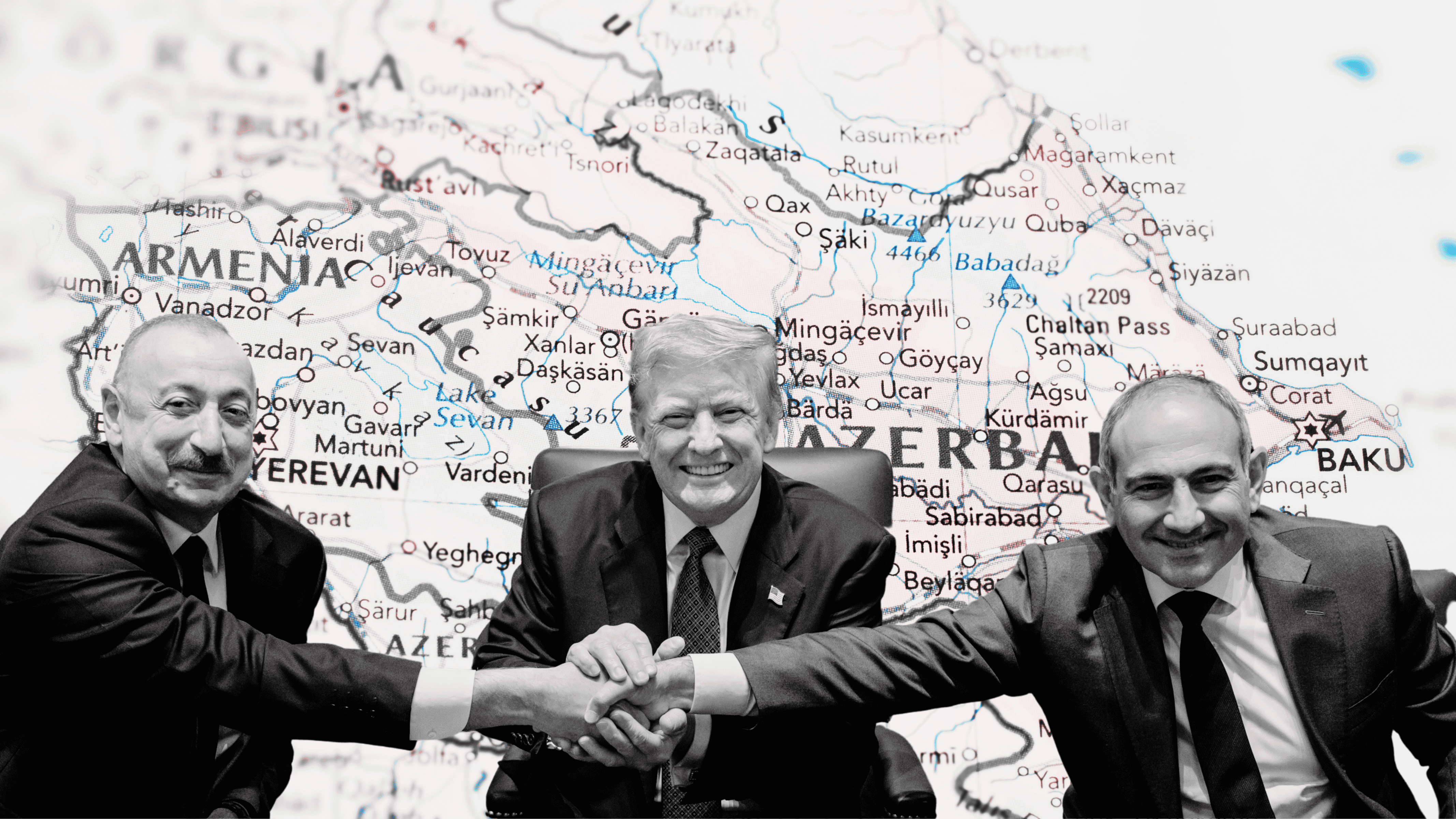
Featured Image: President Donald Trump meets with President Ilham Aliyev of Azerbaijan and Prime Minister Nikol Pashinyan of Armenia, Friday, August 8, 2025, in the Cabinet Room. (Official White House Photo by Daniel Torok)
Related Research
The Strategic Contest Behind the Middle Corridor: Digital Power and the Future of the South Caucasus
American strategy in the South Caucasus and greater Eurasia must look beyond traditional infrastructure. Investing in ports and railways is no longer enough. The US must also invest in secure telecom networks, cloud storage, cybersecurity, digital governance, online finance, and artificial intelligence.
Borderlines and Battlelines: Assessing Regional Security in the South Caucasus
This multi-author report is a collaboration among experts from Armenia, Azerbaijan, Georgia, Germany, Romania, and the United States.