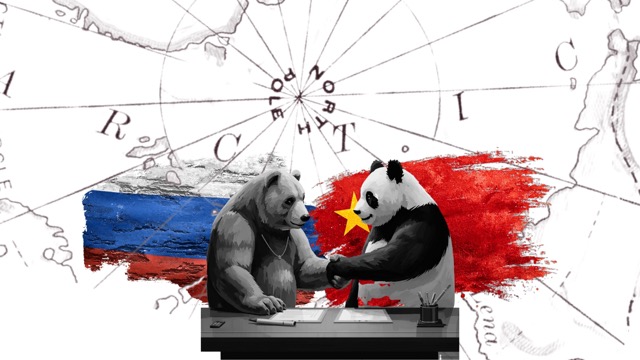

Comrades In Ice: A “What If” Discussion of Sino-Russian Arctic Basing
Is it possible for Russia and China to establish a joint base in the Arctic?
15 May 2036: The Russian Colonel took a drag of his cigarette and watched as the pair of Chinese J-16 strike fighters took off from the Sino-Russian airbase at Ugolnye Kopi, near Anadyr, on Russia’s Bering Sea coast. The Colonel knew that Russian reconnaissance aircraft were already airborne, searching the skies and seas for the Americans. Those reconnaissance inputs, combined with Chinese satellite data, would provide the Sino-Russian intelligence center the information it needed to vector the J-16s over the Bering Sea. The Colonel marveled at how much integration had occurred in just a few short years. In 2028, the Chinese had agreed to pay to upgrade this airbase, and, in return, the Russians allowed the Chinese to maintain a permanent garrison of specialists at the facility and to periodically deploy aircraft there for Arctic operations. The two countries had separate chains of command, but soon developed agreements to share logistical responsibilities, tactical intelligence data, and some operational functions. Russian and Chinese aircraft now regularly operated together near Alaska and the Canadian Arctic coast, sharing data and receiving information from the Sino-Russian intelligence center. Air and ground crews used advanced language translation software and common terminology for real-time communications. The Chinese also paid to expand the nearby civilian port of Anadyr to support more Sino-Russian naval patrols north of the Bering Strait to protect the Northern Sea Route (NSR). The Americans, of course, responded to this new threat with increased air and naval patrols from Alaska, creating a tense environment as Russian, Chinese, and American assets interacted in the tight confines of the Bering and Chukchi Seas. The Colonel smiled again as he took one last drag of his cigarette; it would be a great morning.
Most open-source observers of the China-Russia relationship would probably agree that the scenario outlined above is plausible, but highly unlikely. Despite the growing strength of the China-Russia strategic partnership, it continues to have limits and is not a formal alliance. Unlike NATO forces, Russian and Chinese forces are not interoperable and do not appear to desire that level of integration. In addition, Russia and China continue to have vastly different priorities in the Arctic that make the two parties somewhat suspicious of one another.
That said, while a shared Russia-China military base in the Arctic seems improbable today, it’s not impossible to imagine, particularly if the two countries stop short of forming a full alliance and limit a joint basing effort to one or two locations with narrowly scoped missions. In 2023, the two countries’ coast guards concluded a memorandum of understanding that facilitates closer collaboration in maritime law enforcement, including combined patrolling at sea, that may serve as a model. Furthermore, establishing a joint facility on Russia’s Bering Sea coast may make sense for both sides. Ugolnye Kopi, close to the town of Anadyr, is a few hundred miles southwest of the Bering Strait and the Arctic Circle, but far from the bases that house Russia’s most sensitive strategic assets. It’s also just a few hundred miles from Alaska, the US bases in the Aleutian Islands, and the eastern end of the NSR. The Russian military periodically operates long-range bombers out of the airfield there and reportedly hosted a pair of Chinese bombers at that location in 2024. Regular Sino-Russian operations from Anadyr/Ugolnye Kopi would reinforce the defense of the NSR, increase the potential threat to the US and Canada, and demonstrate the strength of the Russia-China partnership. Engaging in a “what if” discussion of how Russia and China could establish such a shared facility is a useful exercise in identifying how the Sino-Russian security relationship in the Arctic could change over time and the implications for the US.

Map 1: The Bering Sea region showing the proximity of US and Russian territory. The Bering Strait between the two is only about 54 miles wide. The heavier white line is the US-Russia maritime boundary while the lighter one is the international date line. Source: Wiki Commons
The Current State of Play
Russia and China have undeniably strengthened their strategic partnership over the past decade in areas such as diplomacy, trade and economic development, and security affairs. A joint statement from the February 2022 meeting between Russian President Vladimir Putin and Chinese President Xi Jinping says the relationship has “no limits” and “no forbidden areas.” Geopolitically this partnership gives both countries a means to jointly chip away at what they perceive as US global hegemony and efforts to interfere in the domestic affairs of other nations. Both countries have benefited economically from the enhanced partnership with Chinese companies making major investments in Russian energy projects and purchasing vast amounts of Russian oil and gas. Russia, in turn, has reoriented much its economy away from Europe to Asia and China is now its largest trading partner. In the security realm, the two countries have sold one another major weapons systems or their components and cooperated on developing advanced military technology. Combined military exercises involving the forces of both nations have also increased in size and scope on land, sea, and in the air. Finally, China is credited with providing Russia with dual use technology, spare parts, and other materials that enabled Moscow to continue its war in Ukraine despite US and European sanctions.
All that said, the partnership does have apparent limits. For example, the two countries have expressly ruled out a formal alliance. In addition, despite their mutual antipathy towards the US, they have differing strategic interests in many areas around the globe. China remains heavily focused on Taiwan and East Asia while Russia remains focused on countering perceived threats in Europe and attempting to dominate the post-Soviet space. Russia and China also compete for influence in Africa, Central Asia, and Latin America. As to the Ukraine conflict, China has remained hesitant about supporting Russia’s special military operation beyond providing intelligence information, spare parts and raw materials, and dual use technology. As Andras Racz and Alina Hrytsenko point out in a recent article, unlike North Korea, China has not sent forces to fight in Ukraine nor has it provided Russia with more heavy weaponry or ammunition.
In the area of military cooperation, Racz and Hrytsenko note that, despite increased contact, both countries continue to have very different operational priorities, doctrines, and command and control arrangements. Analysis of exercise videos indicates that, while the two countries’ combined exercises have grown more complex, they often appear highly scripted for public relations impact rather than training value. In many cases, Russian and Chinese forces appear to operate in a complimentary manner rather than as an integrated force. Combined air and naval patrols show a definite level of tactical coordination needed for safety, but the integration needed for effective combined operations against an enemy force is not yet evident. To operate a true joint base and conduct effective combined operations, the two countries would probably need to work out mechanisms to allow their forces to support one another and work together more closely. To be clear, the two countries can conduct separate, but mutually supporting, operations in the same or different areas without a high level of integration and still harm a common enemy. But effective combined operations from a joint facility would require more than that.
The Limits of the Arctic Partnership
The strengths and limitations of the Sino-Russian relationship are likewise evident in the Arctic. That cooperation is most pronounced in the economic sphere; both China and Russia see the Arctic as a major new source of raw materials and shipping lanes. For years, Chinese companies have invested heavily in Russian Arctic energy development projects and purchased Russian Arctic hydrocarbons, sometimes despite international sanctions. Chinese and Russian organizations also have agreed to cooperate in turning the NSR along Russia’s Arctic coast into a major international shipping corridor. The two countries have increased scientific cooperation in the Arctic in hopes of increasing economic gains as well.
Despite this investment, the two countries have diverging interests in the Arctic that have probably limited more collaboration. Russia’s huge Arctic territory houses some of its most critical military assets and Moscow clearly sees the untapped resources in the region as a key to Russia’s economic future. Moscow also sees the NSR as an increasingly critical transit route and another source of Russian state wealth. Thus, while Russia needs foreign investment to develop Arctic economic projects, it wants to control foreign access to the region as much as possible to protect its security and sovereignty. In addition, Moscow has jealously protected its status as one of only eight Arctic nations and worked to minimize the influence of non-Arctic states in Arctic governance.
By contrast, while China has been willing to cooperate with others in the Arctic, its formal policy and activityclearly indicate Beijing wants more expansive access to the region, to operate there independently, and to have more of a voice in Arctic governance. Some US officials believe Beijing’s independent icebreaker and submarine operations in the Arctic suggest China has military aspirations in the region, fears that Moscow may share.
Despite enhanced military collaboration elsewhere, actual Sino-Russian security cooperation in the Arctic also remains limited. Since 2021, small groups of Russian and Chinese naval or coast guard vessels have conducted at least four combined patrols in the Bering Sea near the Aleutian Islands. Judging from public reporting, these patrols occurred south of the Bering Strait and not in the area Russia claims as the NSR. Of the ten combined strategic bomber patrols that Chinese and Russian pilots have flown together throughout the Pacific region since 2019, only one occurred in Arctic airspace, in 2024. There is no record of a Sino-Russian combined military event in 2025 in the region.

US and Canadian fighter aircraft intercept a Peoples’ Republic of China H-6 strategic bomber during a combined Sino-Russian strategic bomber patrol in the the Alaska Air Defense Identification Zone, 24 July 2024. Photo by North American Air Defense Command.
Potential Drivers of Change
Russia and China would thus both need to modify some of these policies to establish a joint base in the Arctic and to conduct regular combined operations from it. Several future developments, or a combination of developments, could convince one or both countries to make these modifications. Among the most likely possibilities are:
· Continued Western sanctions, a crumbling economy, and rising war costs increase Russian dependence on China, giving Beijing additional leverage to gain military access to Russia’s Arctic territory and the waters of the NSR.
· Russia’s increased requirements for forces in European Russia to occupy parts of Ukraine and deter a reinvigorated NATO convince the Kremlin to offer China more military access to the Arctic in return for help defending the eastern NSR and the Russian Far East.
· Increased tension with the US over Taiwan and the deployment of additional advanced US military capabilities to Japan and South Korea convince China to approach Russia about establishing a joint Arctic base to threaten Alaska and draw US forces away from the western Pacific.
· Increased NATO military activity in the Arctic threatens both Chinese and Russian interests, providing incentive for more Sino-Russian military cooperation in the region, including joint basing.
· A US build-up of forces in Greenland and Alaska, including long-range strike capabilities, convinces Russia to offer the Chinese military access to Arctic bases for periodic combined exercises as an additional deterrence measure.
Indicators of Change
Should such policy changes occur, the two countries are unlikely to establish a joint Arctic base overnight. The process would take time, likely proceeding in steps. Analysts love to compile lists of indicators to warn of impending decisions or major geopolitical events. This situation is no different. The indicators below are not listed in a particular sequence but offer a glimpse of the kinds of measures two countries would take to build a joint facility.
Also, these indicators should be used cautiously. By themselves, the presence of these indicators could have multiple meanings. For example, construction at any Russian Arctic facility may occur regardless of an effort to build a joint base. Russia and China could also complete some of these steps, such as additional combined exercises in the Arctic, while stopping short of establishing a joint Arctic base. However, it is difficult to see Russia and China establishing a true joint base in the Arctic and conducting effective combined operations from that facility without completing these steps.
More combined training in the Arctic: Before establishing a joint base, Russia and China would likely increase combined military activity in the Bering Sea region or other parts of the Arctic. In addition to symbolism, these events would provide Chinese forces needed Arctic experience the Russians already have and help identify intelligence, logistical, and other support measures needed for more integrated operations. Examples could include additional combined bomber patrols, temporary Chinese fighter aircraft deployments to Russian bases, more combined coast guard or naval patrols in the Bering Sea, or a coastal defense exercise. Both sides would likely publicize these events as a signal to the United States, making them observable.
Staff Dialogue: Coordinating more combined training events or establishing a base at any location would likely require an increased number of working level meetings and senior staff visits. Some of these meetings may be publicized.
Formal agreements: China and Russia already have several formal agreements that provide strategic level guidance on military cooperation. However, since the two countries do not have a formal military alliance, they would likely need additional agreements to establish a common operating location or a true joint base. These agreements do not need to wrap the two countries into a formal defensive alliance; they can be limited in scope so long as they address some basic issues. For example, the two would likely need to agree on the number of Chinese personnel permanently deployed on Russian territory and their legal status. The two would also need to define how logistical, command and control, and security arrangements at the facility would work and who pays which costs. Finally, the two may need to agree on “rules of engagement” in dealing with US or Allied forces in the region to reduce the risk that one party drags the other into an unwanted conflict. Once complete, the two parties are likely to publicize the existence of an agreement as a signal to the US, making it observable.
Infrastructure expansion: Any site chosen for a joint base in Northeast Russia would likely require additional infrastructure or modernization due to the area’s lack of development. Judging from commercial imagery and publicly available data, the civil-military airfield at Ugolnye Kopi, for example, has a lengthy runway but would likely need additional hangers, barracks, and other infrastructure to support both a Chinese and Russian presence. The Chinese may insist on using a Chinese company to ensure its security and logistical requirements are met. The construction would almost certainly be observable.
Conclusion
A joint Sino-Russian base in the Arctic, particularly in the Russian Far East, would have major implications for the US and its NATO allies, particularly Canada. First, China would become a significant military actor in the region capable of continuous operations; currently it is not. Second, the threat to the United States would increase substantially. Advanced Chinese aircraft operating from northeast Russia would be in easy range of US ships, aircraft, and bases in the Bering Sea region, increasing the threat already posed by Russian forces. Chinese bombers or ballistic missile submarines operating from bases in Russia’s Arctic would be far closer to North America than they are now with much shorter weapons ranges, increasing the existing threat from Russia’s strategic forces. Third, specifically in the Bering and Chukchi Sea regions, the risk of inadvertent clashes between Chinese, Russian, and US forces would increase due to the proximity of US and Russian territory. An accident or misjudgment is certainly possible; US officials contend that Russian and Chinesepilots have made unsafe maneuvers near US aircraft many times in the past. In a time of heightened tension, an accident could risk an escalation that would involve three parties, not just two.
However, as noted early in this article, the risk of Russia and China establishing such a facility remains quite low even if the potential impact is high. The two countries do not have a formal military alliance and have very different policies and objectives in the Arctic. Both countries appear satisfied with the level of military cooperation they have now which falls short of integration or “interoperability” as seen in the NATO alliance. Cooperation between the two in the Arctic will probably remain mostly in the economic sphere, which is likely to increase. In terms of military cooperation in the region, a more likely scenario is that Russia and China will conduct a few more combined patrols or small-scale exercises in Russia’s eastern Arctic region. Those events will likely remain under tight Russian control and infrequent with no independent Chinese activity. Any change to that trajectory bears watching.
Disclaimer: All statements of fact, opinion, or analysis expressed are those of the author and do not reflect the official positions or views of the US Government. Nothing in the contents should be construed as asserting or implying US Government authentication of information or endorsement of the author's views.