
Russia’s Arctic: Lack of Ground Forces a Manageable Problem, for Now
Russia’s military planners probably want their counterparts in NATO countries to believe that Moscow is building significant ground force capacity in the Arctic both to deter attacks and to have more conventional military options in the event of war.
In late 2022, then Minister of Defense Sergei Shoigu announced Russia’s intention to increase the size of the Russian military from 1 million to 1.5 million soldiers, to reestablish two Soviet-era military districts, and establish a number of ground and naval infantry divisions throughout the force. Some of these would be based on existing brigades while others would be new formations. Part of that plan would, at least conceptually, more than double the size of the pre-2022 ground and naval infantry presence based in Russia’s western Arctic region. It would also add significant ground forces in Karelia along Russia’s border with southern Finland and around St. Petersburg. Shoigu tied some of these changes to the prospective entry of Finland and Sweden into NATO, remarking that this required a “corresponding troop grouping” in northwestern Russia.
To date, these plans have preceded slowly, and Russia has probably not increased its ground maneuver presence in the Arctic at all. In fact, it has likely decreased dramatically. For example, the Russian Ministry of Defense (MOD) reportedly expanded its 200th Guards Separate Motorized Rifle Brigade (SMRB), which is normally based on Russia’s Kola Peninsula, into the 71st Guards Motorized Rifle Division (GMRD) in the summer of 2025. Although Russian tables of organization are not publicly known, this change would take the unit from an authorized strength of close to 4,000 soldiers to around 10,000 and vastly increase the authorized number of armored vehicles, artillery, and other enablers. However, the 200th SMRB deployed to Ukraine in 2022 where it became famous for taking tremendous losses; any forces allocated to the 71st GMRD and to the other Arctic units have probably been diverted to Ukraine to continue that grinding fight. The ground maneuver forces remaining in the Arctic most likely consist of conscripts and replacements undergoing trainingwith few armored vehicles and little leadership support.
That said, the Russian military still has significant conventional and nuclear capability in the Arctic to defend its interests, capability that NATO planners shouldn’t dismiss. Russia’s Northern Fleet, for example, is small by comparison to its western counterparts, but has an increasing number of surface vessels and submarinescapable of launching Russia’s most advanced missiles at both land and maritime targets. Russia’s Aerospace Forces (VKS) in the High North also have a small, but capable, aircraft presence and have trained to use advanced weapons such as the Kinzhal hypersonic weapon in the region. The Long Range Aviation (LRA) forces frequently fly strategic bombers capable of launching cruise missiles in the Arctic and have multiple bases in the region from which to operate. Finally, Russia has forces in the Arctic that can conduct covert actions such as undersea cable attacks and GPS jamming to intimidate its neighbors while avoiding a shooting war. So, while the lack of ground maneuver forces does imply that Russia has capability gaps in its Arctic defense plans, Russian commanders are not without options in the region.
The Role of Ground Maneuver Forces in Arctic Defense
Prior to Russia’s 2022 invasion of Ukraine, Russia had just three resident ground maneuver brigades in the Arctic with an estimated authorized strength of between 10,000-15,000 soldiers. Actual numbers aren’t publicly available. These were the 200th SMRB and the 80th Motorized Rifle Brigade (MRB) at Alakurtii, both part of the 14th Army Corps. The Joint Strategic Command Northern Fleet, which had responsibility for Arctic defense at the time, also had 61st Separate Naval Infantry Brigade (SNIB) at Pechanga on the Kola Peninsula. The region also hosted a coastal defense missile brigade, a maritime reconnaissance unit, and a marine engineering regiment although these are not counted in the estimate above as they are not traditional maneuver units. Based on estimates of their authorized strength, deployment, and exercise activity, these three maneuver units had two main missions: defend the border areas with NATO member Norway and counter any enemy landings on Russia’s Arctic coast or on the islands that dominate the Northern Sea Route (NSR). This second mission was probably tied closely to the growing importance of Russia’s Arctic and the NSR to Russia’s future economic life.
All three of these brigades deployed virtually all personnel and equipment to Ukraine in 2022 where they incurred tremendous losses. In February 2023, the Norwegian Intelligence Service estimated that Russia’s ground force capacity in the Arctic was about one-fifth of its pre-war level. Like other units in Russia, the home garrisons of these three units have concentrated on training replacements for its deployed elements and likely have little capability for more than small-unit missions.
Russia’s Defense of the Arctic After Ukraine
There’s no question Russia sees the need for a dominant position in the Arctic as a key to its future as a world power. Russia bases some of its most critical military assets in the Arctic and Russian leaders contend that the country’s economic future depends on development of vast untapped resources in the region. For the last decade, senior Russian leaders have complained publicly about what they perceive as emerging threats to Russia’s Arctic interests, including efforts by unfriendly countries to contain Russia’s activities in the region. More specifically, Russian leaders point to increased US and Allied military activity in the Arctic as provocative, turning the region into a zone of confrontation rather than cooperation. At the same time, these senior Russians refuse to acknowledge that Russia’s own Arctic military modernization program andprovocative exercises in the region are partly responsible for Allied concern. Finland and Sweden’s decision to apply to enter NATO in 2022 may have thus accelerated plans the Russians already had for increasing ground presence in the Arctic.
Shoigu’s 2022 announcement called for reestablishing the Soviet-era Leningrad Military District (LMD) and the Moscow Military District, and President Vladimir Putin signed an official decree to do so in early 2024. The LMD is probably responsible for defending Russia’s northwestern territory, the St. Petersburg area, and the Baltic region including Kaliningrad; its area of interest probably covers the Barents Sea, the Norwegian Sea, all of Scandinavia, the Baltic States, and the Baltic Sea. In the Arctic, plans for the LMD called for expanding the 200th SMRB into the 71st Guards Motorized Rifle Division (MRD), expanding the 61st SNIB into a full division, establishing an artillery brigade, and leaving the 80th MRB as a brigade sized element. In 2023, some Russian press reports suggested the MOD is considering expanding the 14th Army Corps into a combined arms armywhich would provide it with additional artillery, rocket, and other enabling capabilities. If all these changes take place, the number of soldiers and naval infantrymen authorized in these formations would go from an estimated 10,000-15,000 before the war in Ukraine to well over 30,000. Whether these units would be at full or partial readiness pending mobilization is unclear.
The above figures don’t include other forces that would be added to the LMD south of the Arctic Circle in Karelia, the Leningrad Oblast, and Kaliningrad. There the MOD plans to expand three existing brigades into divisions and to add another army corps northeast of St. Petersburg. While outside the Arctic, these forces could still potentially reinforce units in the High North or threaten southern Finland and the Baltic States. Since the 2022 announcement, movement on these plans has been slow with little real progress. In the Arctic, the 104th Artillery Brigade was reportedly established at Kandalashka in the Murmansk Oblast in late 2023 and, as noted, the 200th SMRB was reflagged as the 71st Guards MRD. There’s no indication of when the 61st SNIB will officially expand and, since about 2023, there have been no additional reports of expanding the 14th Army Corps into a combined arms army. To the south, the LMD has formally expanded two ground force brigades into divisions and established the new 44th Army Corps along with an Iskander-equipped rocket brigade in Karelia.

(Map of Military Districts of Russia. Source: Farjanaontu, CC0, via Wikimedia Commons)
Most analysts, including some European intelligence organizations, doubt that the new or expanded ground formations have received significant personnel or equipment, nor will they for some time. As noted, the existing units suffered extensive combat losses and Moscow is almost certainly diverting any new personnel and equipment needed for these expansions to Ukraine. In the longer-term, progress on building up real capacity in these units is dependent on how the conflict in Ukraine plays out. Real gains can’t be made until combat operations end and Russia decides how big a force it needs to hold any Ukrainian territory it may retain. The MOD will then have to decide where priorities for reconstitution and expansion lie. Presumably units near the Ukrainian border area will take priority. In its May 2025 study of this issue, the International Institute for Strategic Studies estimated that fully equipping the expanded force that Shoigu envisioned would likely only become possible between 2030 and 2035 if combat operations ended in 2025, state financing remained at 2025 levels, and workforce patterns in Russian industry remained unchanged.
This assessment implies that the Russian military will have a substantial capability gap in the Arctic for years. Unless it can quickly redeploy airborne, ground, or naval infantry units into the theater from Ukraine or other areas, it will have only the coastal defense cruise missile units, border guards, and some conscripts to defend critical bases in the Arctic and hold key ground along the borders with Norway and Finland. Large-scale expeditionary missions in other parts of the Arctic with ground or naval infantry components will be problematic. Russia has conducted some well-publicized amphibious landing exercises in the Arctic since the start of the war, but video suggests they were relatively small with just a few vehicles and personnel. They were clearly staged for publicity purposes rather than as major training events.
However, the Russian military is not without options. To begin with, Russia is probably already trying to deter attacks on its territory by conducting covert and overt non-kinetic actions designed to worry the populations of neighboring states, undermine confidence that their governments can protect them, and weaken NATO unity. For example, since 2017, GPS jamming has occurred in parts of Norway, Finland, and the Baltic region that many western observers attribute to Russia. During a September 2025 Russian exercise on the Kola Peninsula, GPS jamming forced a Norwegian civilian aircraft to abort a landing. In addition, some European governments have blamed the Russians for operating unidentified drones near airports and military facilities in Denmark, Norway, and Germany that disrupt operations, a claim Moscow denies. Russia has also moved some of its naval live fire exercises very close to the Norwegian border and into Norway’s Exclusive Economic Zone.
More importantly, Russian forces have the capability to conduct long-range strikes against critical civilian infrastructure, operating bases, or troop formations deep inside Scandinavia and western Europe from the Arctic, northwestern Russia, and even the Baltic Sea. These types of operations are fundamental parts of Russia’s doctrine and Russia has utilized them extensively in Ukraine. Doctrinally they serve to both psychologically demoralize the enemy’s population as well as degrade a country’s ability to support military operations. These actions can occur either preemptively as geopolitical tensions transition to open conflict or after large-scale operations begin. The Russian Navy, VKS, and LRA all have platforms capable of launching the weapons used for such operations and experience in Ukraine shows they have vastly improved their ability to do so. For example, an excellent 2026 Royal United Services Institute (RUSI) study explains how the Russians have learned to coordinate the launch of hundreds of small, cheap Geran one-way attack (OWA) drones with those of conventional cruise missiles, ballistic missiles, and aero-ballistic weapons aimed at deeper infrastructure targets to confuse Ukrainian air defenses and increase the likelihood these major weapons will reach their targets. The Russians have also equipped these longer-range munitions with countermeasures and more complex terminal maneuvering to confuse high-end air defense systems like the US Patriot. The platforms that launch these weapons are based in the Arctic and in the Baltic region or operate from there regularly.
On the tactical side, the same RUSI study shows that, contrary to the immense losses in tanks and armored vehicles in the ground forces, the Russian VKS lost relatively few of their most advanced fighters and fighter-bombers and have actually increased their number with new production. Pilots of these aircraft now have four years of combat experience flying against Ukraine’s air defense system and in cooperating with Russian ground-based air defenses to improve their situational awareness. These pilots also have experience using newer longer-range air-to-air missiles against Ukrainian aircraft as well as improved glide bombs against troop concentrations, garrisons, and other infrastructure. Both improve VKS stand-off range, lethality, and survivability.
Conclusion
This is not to argue that Russia would win a shooting war with Allied forces in the Arctic or elsewhere; it does mean that, even without a substantial ground presence, Russian forces in northwest Russia using conventional weapons could prove highly lethal for a time despite the massive losses in Ukraine. How long Russian forces could fight in this way and defend Russia’s Arctic interests isn’t clear. It’s important to note that the Bulletin of Atomic Scientists estimates that Russia has approximately 1,500 non-strategic nuclear weapons it could resort to as well, and that many of the same weapons systems used for long-range conventional strikes have nuclear variants. In 2024, Russia reportedly broadened the range of contingencies in which it might resort to nuclear weapons, and at least one news report suggests that non-strategic nuclear weapons could be used if an enemy force lands on Russian territory or threatens to defeat Russian forces defending a border area. Given that Russia has few effective ground forces in the Arctic, a scenario in which Russia believes an Allied invasion of its Arctic territory is imminent may vastly increase the risk that Russia could resort to nuclear weapons.
Allied military planners should thus concentrate first on increasing national and Alliance capability to reduce the effectiveness of the combination of cheap drones and long-range weapons launched against Alliance territory rather than building a 21st century version of the Maginot Line. In addition, they should put mechanisms in place to collectively monitor the build-up of Russian ground forces in the Arctic and the other parts of the LMD to determine if, and when, they become an offensive threat. These new and expanded forces will need new garrisons; construction of those should be easy to track. These new and expanded units will require new equipment; deliveries should also be easy to track. Finally, these units won’t become a major concern until they can perform at least battalion-level missions. Although more difficult to judge, western analysts can make assessments of this capability based on a range of information. Monitoring all these developments and determining how best to mitigate wartime use of all Russian capabilities will require cooperation between Allied nations, something that could become fragile in today’s geopolitical environment. Undermining Allied unity may be Russia’s best strategy for defending, and even advancing, its Arctic interests.
Table: Russian Army Unit Sizes (Estimate)
Unit Level | Typical Subordinate Units | Authorized Strength (Varies Widely) | Notes |
Brigade | 3–6 battalions | 3,000 – 4,500 | Standard independent combined-arms formation |
Division (for context) | 2–4 regiments | 8,000 – 10,000 | Not always present; Russia uses both brigades and divisions |
Corps / Army Corps | 2–3 brigades or divisions | 10,000 – 20,000 | Transitional operational level (varies widely) |
Combined Arms Army (CAA) | 2–4 brigades/divisions + support units | 20,000 – 35,000 | Core operational field army |
Note: Actual personnel numbers will probably not equal authorized strength until mobilization.
Disclaimer: All statements of fact, opinion, or analysis expressed are those of the author and do not reflect the official positions or views of the US Government. Nothing in the contents should be construed as asserting or implying US Government authentication of information or endorsement of the author's views.
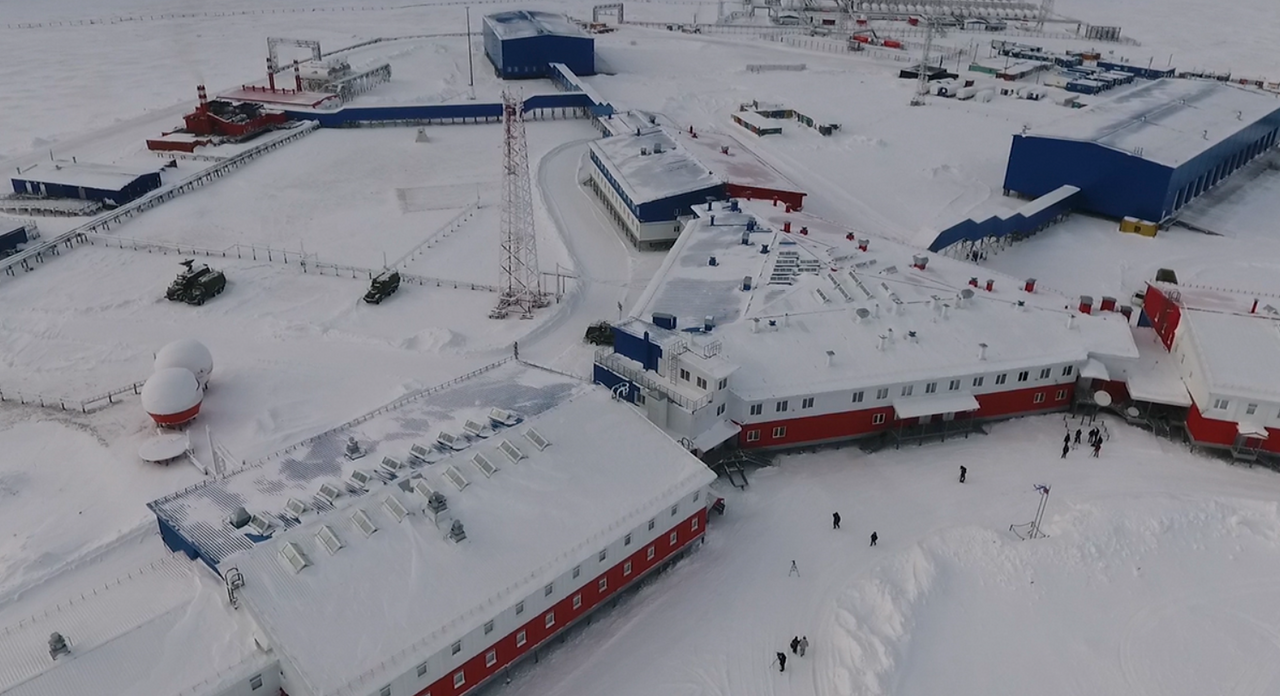
Featured Image: Russian Arctic military base Northern Clover, April 2019.
Featured Image Credit: Mil.ru, CC BY 4.0 <https://creativecommons.org/licenses/by/4.0>, via Wikimedia Commons
Table - Russian Army Unit Sizes (Estimate) Sources: