
Russia’s Arctic: Major Obstacles Challenge Moscow’s Vision and Future Profitability
In attempting to persuade the United States to support Russia’s objectives in Ukraine, lift sanctions, and rebuild a bilateral relationship, Moscow is enticing the Trump administration with the lure of untapped resources of the Russian Arctic.
While visiting Alaska in August 2025, Russian President Vladimir Putin reportedly discussed renewed US-Russia collaboration in the Arctic with President Trump. In March, Kremlin envoy Kirill Dmitriev, head of Russia’s Direct Investment Fund, said that the Arctic is “too important for Cold War style politics” and that the US and Russia must find “common ground” to jointly develop the region’s wealth. Later he proposed digging a tunnel under the Bering Sea between Russia and Alaska to facilitate bilateral exploitation of Arctic resources. He claimed it could be built for about $8 billion US dollars, far less than earlier $65 billion dollar estimates.
This push for economic cooperation in the Arctic isn’t a surprise. For years, Putin and other Russian officials have argued that development of Russia’s Arctic resources, transportation routes, and military posture are vital for Russia’s future. The scale of Russia’s ambitions requires foreign investment and technology. Western sanctions in the wake of Russia’s 2022 invasion of Ukraine have dramatically slowed Russia’s ability to achieve its ambitions while increasing Moscow’s reliance on Beijing. The Trump administration’s interest in more hydrocarbon sources and critical minerals would seem to make sanctions removal and intensified US-Russian Arctic cooperation a natural starting point for Trump’s “America First” policy.
Setting aside the dubious strategic logic of undermining Ukrainian independence and NATO unity in this approach, would investments in Russia’s Arctic projects make economic sense for US companies—or even the US government? Probably not. Russia’s Arctic vision faces significant risks to long-term profitability, including high upfront infrastructure costs, an unpredictable regulatory environment, volatile global commodity prices, and the possibility that broader geopolitical tensions will disrupt projects. Better opportunities exist in North America.
Russia’s Strategy and Plans: A Brief Overview
About a quarter of Russia’s territory lies in the Arctic and Russian officials believe it contains substantial hydrocarbon and critical mineral reserves that are key to Russia’s economic future. Since at least 2008, the Russian government has advanced several state policies and strategies, provided funding, and encouraged both Russian private and foreign investment to achieve some very lofty goals. Russia’s official 2020 Arctic strategy, for example, states that about 80% of Russia’s natural gas and 17% of its oil resources are already produced in the Arctic and that enormous reserves are located on Russia’s Arctic continental shelf. The same strategy says Moscow wants to increase liquified natural gas production in the region from an estimated 8.6 million tons in 2018 to 91 million tons by 2035.
To reach markets, producers need to ship most of these resources through the often icy seas located north of much of Russia’s Arctic coast, a vast region Moscow calls the Northern Sea Route (NSR). In addition to Russian natural resources, Russian officials have promoted the NSR as a cheaper corridor for container ships traveling between Europe and Asia, arguing that it would cut about two weeks off the transit time normally needed to go via the Suez Canal. As of 2022, Moscow’s targets for increased shipping on the NSR are 80 million tons by 2024, 150 million tons by 2030, and 220 million tons by 2035.
At the same time, Russian officials have had to balance their need for foreign investment and presence in the Arctic with their traditional fears about foreign military threats to Russia’s Arctic interests. These fears have only intensified since Russia’s 2022 invasion of Ukraine. For example, in July 2025, Putin confidant Nikolai Patrushev, head of Russia’s Maritime Collegium, said that the US and its NATO Allies want to contain Russia’s activities in the Arctic and take resources for themselves; US and Allied attacks on Russian shipping and infrastructure therefore can’t be ruled out. These views are reflected in official Russian policy documents as well. As a result, Moscow has aggressively modernized its Arctic military and coast guard capabilities, passed several laws to control foreign access to the NSR, and closely monitored foreign investment and activity in the region.
Environmental and Infrastructure Challenges
Unfortunately for Moscow, major economic development projects in Russia’s Arctic face numerous obstacles that delay implementation and increase costs. Some of these obstacles are environmental while others stem from underdevelopment in Russia’s Arctic territory. In addition, profits are subject to fluctuations in global commodities prices that are often impacted by geopolitical developments. Many of these obstacles are likely to persist and cost Moscow and its investors significant sums, reducing long-term profitability regardless of what happens with sanctions.
The challenges begin with the extremely cold and remote nature of the region. Winters are long with average temperatures well below freezing. Ice and bad weather are prevalent for long stretches of the year. Climate change will probably warm temperatures by several degrees for longer periods, but the region will still suffer from long cold winters and the accompanying polar night that make construction, drilling, mining, and shipping more difficult and expensive.
In addition, large portions of Russia’s Arctic lack the infrastructure needed to support complex extractive operations and move raw materials to markets. Only about 11 percent of Russia’s railways lie in the Arctic, and much of that is in the far west. The vast central and eastern portions of Russia’s Arctic have very few rail lines and depend on river and ocean transport to move material when conditions permit. While several ports exist along this stretch of coast, most are relatively small by international standards, with shallow draft limits, limited berthing space and cargo handling equipment, and seasonal ice restrictions, judging from information available in a commercial shipping database.
To become viable, many Russian gas, oil, and critical minerals projects require large upfront investments in infrastructure both to extract resources and move them to markets. Despite government support, infrastructure projects face headwinds due to the need to move construction materials over vast distances, the challenge of building in extreme cold, and the increasing problem of permafrost thaw. Permafrost underlies about 65 percent of Russia’s total territory, and permafrost thaw due to climate change is already destabilizing the ground under buildings, roads, and other critical infrastructure. Damage includes cracking foundations, collapsed roadbeds, and heavy flooding of areas that were once firm ground. In 2021, the Russian news agency TASS estimated that 40 percent of the foundations of buildings and other structures in Russia’s permafrost zone were already damaged. Cost estimates for mitigating harm to existing infrastructure vary widely. A 2024 Russian government estimate put the cost at about $53 billion US dollars by 2050. By contrast, a 2022 estimate in the journal Environmental Research Letters indicates damage could run between $115 and $169 billion US dollars. Adaptation of building practices for permafrost thaw is expected to add to the already high cost of new infrastructure in this remote region.
Rosneft’s Vostok Oil, a project to tap oil and gas deposits in the central Arctic areas of Krasnoyarsk Krai and Yamalo-Nenets Autonomous Okrug, provides a case study of these challenges and the potential risk for investors. According to news reports from 2021, Rosneft claimed the venture would be the largest oil and gas project in the world and require between $150-160 billion US dollars of investment. Another contemporary news report said the company planned to build 15 industry towns, 3500 kilometers of power lines, a 2000-megawatt power source, 800 kilometers of pipeline, and a shipping terminal to support the project in an area with almost no existing infrastructure. Much of the ground on which operations will take place consists of permafrost. The company also planned to build 10 reinforced tankers capable of operating in heavy sea ice (known as Arc7 ice-class tankers) to move the crude oil and liquid natural gas via the NSR. Independent analysis published in 2023 suggests the project would become profitable in the late 2020s if global benchmark crude prices averaged roughly $70–90 per barrel.
Since 2024, delays in project implantation have slowed development while US government sanctions have caused some foreign investors to pull out of the project. The sanctions also complicated Rosneft’s ability to gain access to equipment needed for drilling in this difficult environment and are probably delaying production of the tankers. As a result, the company had to delay completion of its first phase of the project from 2024 to at least 2026. In addition, prices on the global market for Russian crude oil have dropped over the last several years due to sanctions and oversupply. In 2025, for example, Russian Urals crude averaged roughly in the mid-$50s per barrel for Russian tax purposes, but market transaction prices were frequently lower — often significantly discounted relative to Brent crude — as exporters offered price concessions to secure buyers amid ongoing sanctions and compliance risk. Even if an end to sanctions relieves this burden somewhat, the difficult operating environment, the future global price of oil, geopolitics, and climate change will strongly influence the long-term profitability of this project. Investors beware.
The Northern Sea Route: Ice Free? Regulation Free?
As noted, Russia is touting the NSR as a shorter and cheaper alternative to the Suez Canal between Asia and Europe, and it needs the NSR to move Arctic hydrocarbon resources to Asia. A key to this argument is a general belief that warmer temperatures from climate change will dramatically reduce Arctic sea ice and make the NSR navigable for longer periods each year. Russia is thus attempting to expand the port capacity, services, and shipping needed to facilitate year-round transit along the NSR and is looking for foreign investors to provide additional funding and technical support. As of June 2023, official plans called for about $24.58 billion US dollars of investment over a thirteen year period, about a third of which would come from the Russian government. Given that one Russian news report says the NSR will require up to 100 additional ice-class vessels to support Russia’s objectives, that estimate is probably too low.
Russian claims on the future year-round usability of the NSR are probably exaggerated, and investments in the infrastructure and services of the NSR will likely remain risky. Judging from analysis published by the Bellona Foundation and the International Transport Forum, hazardous sea ice conditions, shallow waters, severe weather, and prolonged periods of darkness that currently hamper shipping on the NSR are likely to persist to some degree despite climate change. For example, while climate change will reduce vast areas of thick pack ice for longer periods each year, large ice floes will probably still drift in Arctic waters posing dangers to transiting ships even in the summer. In addition, the waters along the Russian coast and through several straits on the NSR are quite shallow with shifting bottoms, forcing larger ships to travel north into deeper waters where ice floes may be larger and thicker. In terms of weather, the region is plagued by heavy fog in the summer months and perpetual darkness in the winter which will continue to cause ships to move slowly to avoid catastrophe. In fact, warmer temperatures may increase the incidence of fog. These factors raise the cost of insurance. As of 2019, insurance costs were twice as high for a ship using the NSR compared to ships using the Suez Canal. Climate change may not alter that significantly.
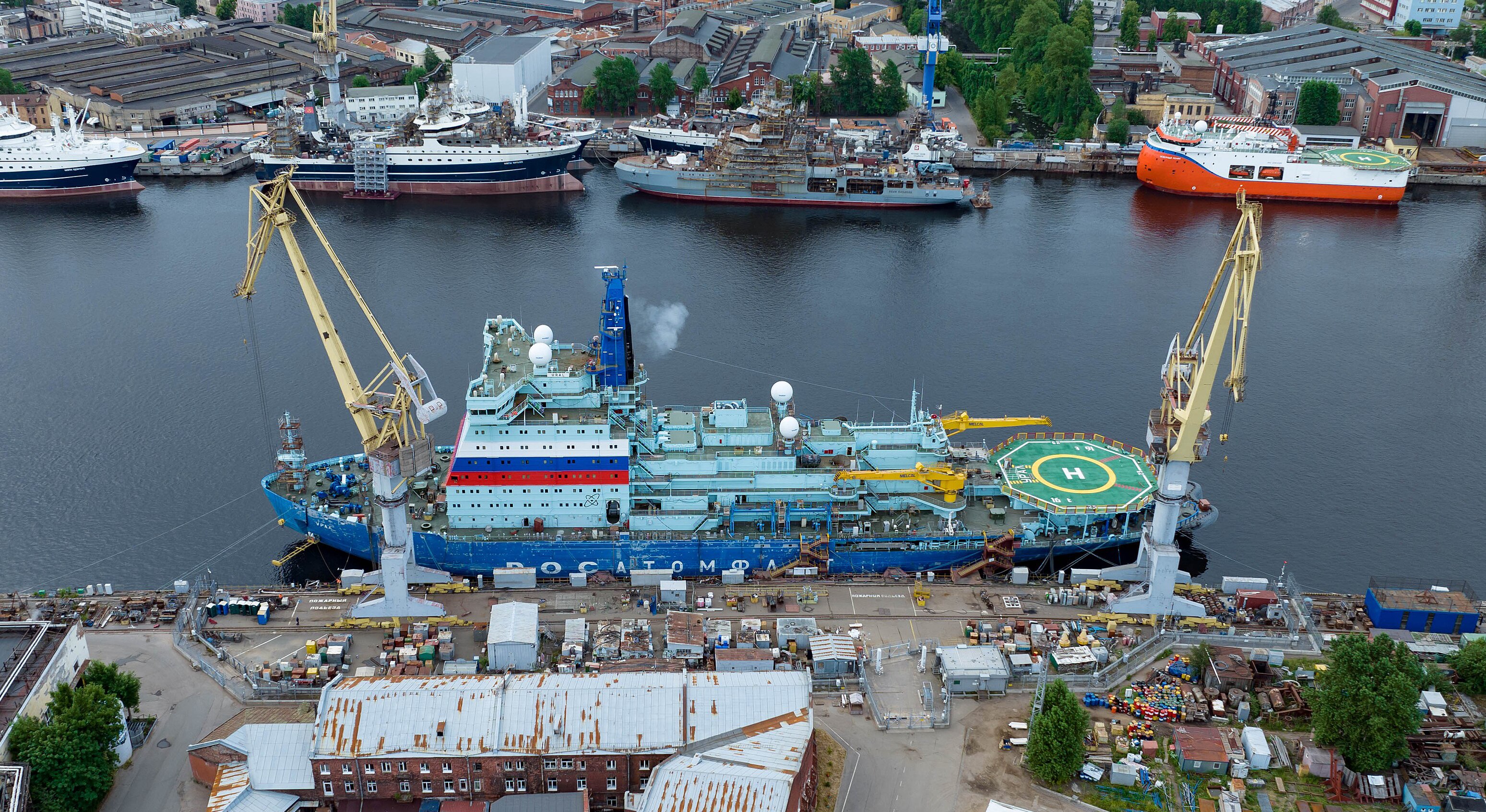
The continued presence of ice for much of the year will require use of ice-class vessels that are built to withstand contact with varying amounts of ice and that have crews trained to operate in icy conditions. These ships are more expensive to build and operate than standard cargo ships and tankers and many of them still require icebreaker support to get through the thickest icefields. Even with icebreakers, movement is slow through icy waters, increasing the number of transit days and the risk to ships. For this reason, Russian government strategies call for building additional icebreakers, including nuclear-powered heavy icebreakers, but sanctions and cost overruns have caused delays and some cancellations in these programs. The Russians do allow non-ice-class vessels to use the route, particularly from the “shadow fleet” of oil and gas tankers, but risk to these vessels from ice damage, and thus to the environment, are quite high.
Finally, Russian law imposes additional requirements for foreign access to the NSR that could discourage future use of the corridor and even increase global tensions. These measures probably stem both from a desire to gain additional revenue and to control foreign military access to a strategic region. For example, Russia claims international law gives it the right to regulate commercial traffic through the NSR and that four of the straits along the corridor are internal waters. Russian law therefore requires commercial vessels to obtain permits to sail through the region and, where ice conditions warrant, to employ Russian pilots and icebreakers. These requirements impose additional regulatory constraints and financial burdens on shippers seeking to use the route. Foreign warships are not subject to those same requirements, but are required to obtain diplomatic clearance to transit the four straits. Other governments contend that these measures violate international law and the principle of freedom of navigation. Together with Russia’s intensified military activities in the Arctic, these practices contribute to rising regional tensions and may increase the long-term political and commercial risks associated with Arctic investments.
It is telling that, in spite of Russia’s efforts and the personal interest of Vladimir Putin on development of the NSR for more than a decade, Russian government statistics show that only about 37.9 million tons of cargo transited the NSR in 2024, less than half of the benchmark for that time set in Moscow’s official plans. The vast majority of that was Russian hydrocarbon resources. Once again, investor beware: the conditions inherent in the Arctic and Russian government policy are not likely to change much, calling into question the long-term profitability of the vast infrastructure projects needed to make Russia’s shipping vision a reality.
Chinese Partners?
Chinese participation in Russia’s Arctic projects poses additional potential risk for US companies interested in them. Chinese companies have already provided extensive investment in several of Russia’s Arctic projects as part of China’s policy to increase access and presence in the region. Assuming sanctions on investment in Russia’s Arctic are lifted, American companies could partner with Russian and Chinese companies on new projects in the region but would face several potential concerns. First, individual Chinese companies may face US sanctions for other reasons outside the Arctic, restricting the options for the US companies involved. American law may prevent needed technology transfer as well. A future geopolitical development may cause US Congressional or shareholder concern that could complicate continued US participation in these Arctic partnerships once they start. Once again, investors beware.
Conclusion
At least one large US-based multinational energy company has already reassessed its future involvement in Russian projects even if sanctions are lifted. Exxon Mobile said in 2025 that it has no plans for new investments in Russia and is focusing instead on managing existing assets and gaining a settlement with Moscow for assets that were expropriated in 2022. The company doesn’t say why it won’t return, but Exxon’s experience in Russia, the geopolitical environment, and high structural risk to future investments in Russia’s Arctic are probably playing major roles.
In addition, there are probably safer and more stable alternatives to Russia. Alaska and Canada already produce hydrocarbons and have additional reserves. Exxon already operates in Alaska as do many other companies. Alaska and Canada are both reported to have substantial critical minerals deposits. The infrastructure to move products to markets is already better, and construction would probably be less costly than in Russia. The regulatory environment in Alaska and Canada is more stable, and the geopolitical risk is probably lower. Finally, investments in Alaska and Canada would put “North America first.” By contrast, American companies should stay away from Russia’s Arctic projects; there’s just too much risk.
Disclaimer: All statements of fact, opinion, or analysis expressed are those of the author and do not reflect the official positions or views of the US Government. Nothing in the contents should be construed as asserting or implying US Government authentication of information or endorsement of the author's views.
Image: Russian nuclear-powered icebreaker Ural at the pier of the Baltic Shipyard, photographed from above. Saint Petersburg, Russia, July 2022. Image Credit: Nikolai Bulykin, CC BY-SA 4.0 <https://creativecommons.org/licenses/by-sa/4.0>, via Wikimedia Commons
Related Research
Comrades In Ice: A “What If” Discussion of Sino-Russian Arctic Basing
Is it possible for Russia and China to establish a joint base in the Arctic?
Russia’s Arctic: Lack of Ground Forces a Manageable Problem, for Now
Russia’s military planners probably want their counterparts in NATO countries to believe that Moscow is building significant ground force capacity in the Arctic both to deter attacks and to have more conventional military options in the event of war.